

German Language Course

German Language course
We offer German A1 beginner level to German C2 mastery level at Indian Institute of Foreign languages....!!!!!
Call Us : Free Demo class
080-46805600 | +91 9066038847
Introduction
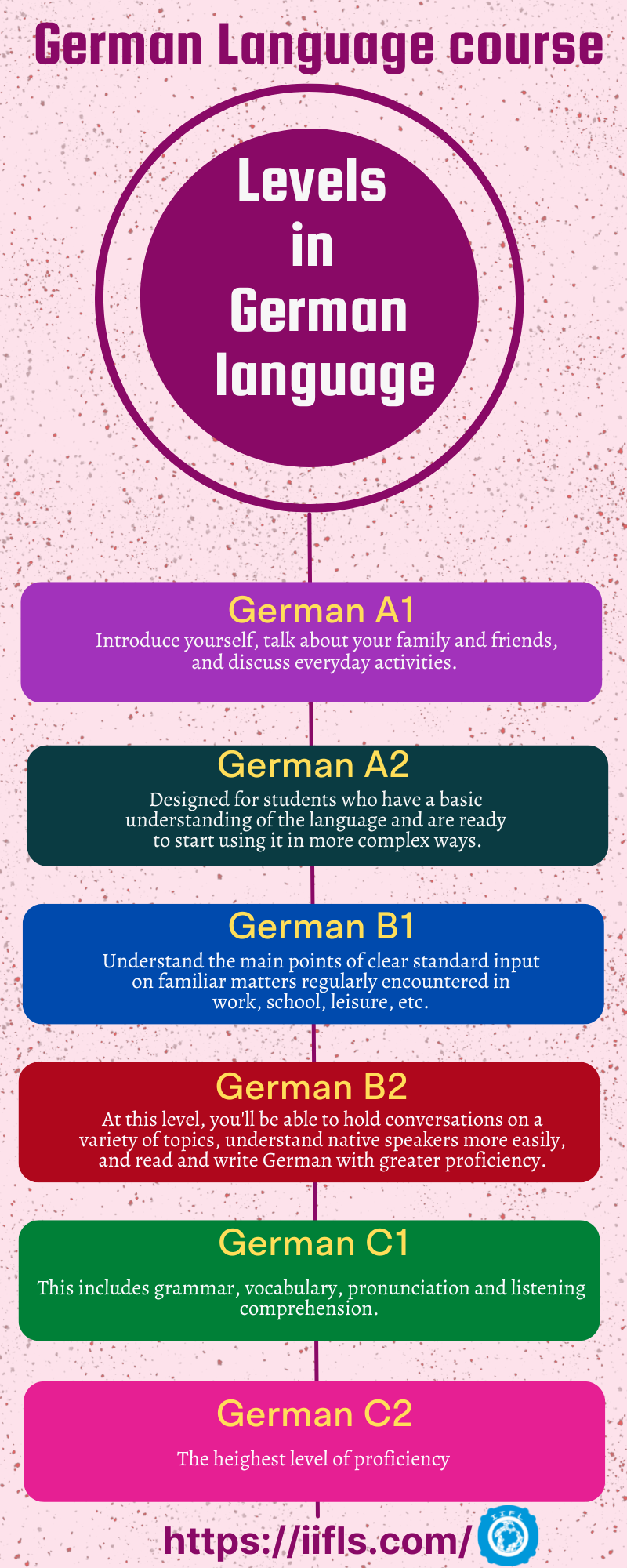
German language Course: There are six levels in the German language according to the common European framework of reference for languages (CEFR). We offer training for all six levels. Would you like to know what you will learn at each level & how much German you will know at the end of each level? If your answer is yes read this article. There are six levels in the German language do i need to learn all six levels or one or two levels should be fine ?? If you would like to know what you should learn depending on the purpose you want to learn? A spouse visa requires A1 level certification, undergraduate students who want to study German-taught Bachelor's degree program need to learn till the B2 level, and details of German language requirements for specific purposes are mentioned in this article read further to know more If you're looking for a comprehensive German language course, look no further! In this blog post, we'll introduce you to the best German language course out there. We'll also give you some tips on how to learn German effectively so that you can reach your language goals in no time. 
Get Rs.2600 Discount on Combo Offer 1
Get Rs.7400 Discount on Combo offer 2
Call Us to learn more about the offer
080-46805600 | +91 9066038847
German course A1 (Online or Classroom Training)
| Course Duration | 60 Hours |
| Course Fee | Rs.13,800/- for online classes Rs. 18,800/- for offline classes Call us for combo offers |
| Fee For international students | Rs.13,800 call us for offers Including study material (Hard copy ) Study Materials included in the fees Courier charges to your location not included |
| Study Material (No additional charges) | Textbook Workbook Glossary Basic Grammar book |
| Teaching methodology | Interactive & Emphasis on all four modules Reading, Writing, Listening & Speaking |
| Certification & Examination | Course completion Certificate issued after completing the course & Internal exam will be conducted at the end of the course. (Certificate can be used for German University admissions Except for few universities) |
German course A2
| Duration | 60 hours |
| Course Fee | Rs.13,800/- for an online course (Live classes) Rs 18,800/- for an offline course |
| Study Material for German language online course |
|
| Teaching Methodology | German online language classes are extensively interactive and involve training in four modules
|
| Certification | Course completion Certificate issued after completing the course (Certificate can be used for German University admissions Except for few universities) |
| Examination | An internal exam will be conducted at the end of the course |
German course B1
Learn more about German B1 syllabus
| Course Duration | 70 Hours |
| Course Fee | Rs.18,800 (Nov 2021) |
| Study Material | Included in the fee
|
| Modules |
|
| GST | Included in Fee |
| Exam Preparation | You will be prepared for German B1 Level international certification Exam |
| Study Material for Exam Preparation | Included a photocopy of model test papers of International certification exams. |
| Certificate | Course completion certificate will be issued after successful completion of Course |
| Examination | Internal Examination conducted at the end of the course |
| Mode of classes | German online classes & German classroom training both are available |
what you will learn at each level & how much German you will know at the end of each level?
German Level | What you will learn at this level |
| German Level A1 | Alphabets, numbers, colors, vocabulary related to day-to-day activities, Introduce yourself, Introduce others, Read sign boards, Book appointments, and understand instructions on airports or railway stations. |
| German Level A2 | Read and fill out Application forms, Write short messages, Speak about hobbies and routines, Able to speak to with German native speaker if he/she speaks with a very low phase & presentence sentence structure |
| German Level B1 | Understand the Main points of clear standard input on familiar matters regularly encountered in school, workplace, leisure, etc |
| German Level B2 | At this level, you will be able to hold conversations on a variety of topics understand native speakers more easily, Read and write German with Proficiency |
| German Level C1 | You Will be a master at this level, able to read and understand German literature, able to watch dram, movies & scientific documentaries. |
| German Level C2 | The highest level in German Learning as a foreigner. |
How many levels of the German language are required depending upon your purpose?
Purpose | German language Requirement |
| To Study Master's Degree in Germany –English program | Depending upon the university, some universities don’t require the German language to give admission, Few universities require till A2 or B1 level, even though the entire program is taught in English. Due to the increased number of applicants to Germany if you know the German language chances of getting admission |
| To Apply for a Student visa to study master's degree- English taught the program | German Certification may not be mandatory but including German Certification increases your visa success rate |
| To Study Bachelor Degree in Germany - German taught Program | B2 Level is a minimum requirement, But the preferred level is C1 |
| To apply for a student visa, to study Bachelor's Degree in Germany - German taught Program | German certification Till B2 mandatory |
| To Study Bachelor Degree in Germany – English taught Program | To Study Bachelor Degree in Germany - German taught Program |
| To Study Masters in Medical courses | German certification Till C1 mandatory |
| To Apply for Spouse Visa | German certification A1 mandatory |
| To Apply for work Visa | German certification Till B2 mandatory |
| To Get a pat time Job | Job which involves customer interaction requires till B1, Jobs without customer interaction requires no German |
 Sign up for offers[/caption]
Levels in German language course.
For anyone who has studied a foreign language, you know that there are different levels of proficiency. The same goes for German. In this blog post, we will explore the different levels of German and what they entail. Whether you are just starting to learn German or you have been studying for years, it is important to know which level is right for you. Read on to find out more about the different levels of German and how to gauge your own proficiency. Learn more about german tutors near me
Each level has different requirements for speaking, reading, writing, and listening comprehension
The four language skills of reading, writing, speaking and listening are often taught together, but they can also be taught separately at different levels. The level of difficulty for each skill varies depending on the person's native language and their learning goals. For example, a person who is a native English speaker may find it easier to learn to read German than to speak it. On the other hand, someone who is a native German speaker may find it easier to write in German than to understand spoken English. The important thing is to choose a level that is appropriate for your own individual needs and abilities. We at Indian Institute of Foreign Languages conducts German Language course guides you to earn mastery in the language. Know more about german gpa calculator
The following is a general guide to the different levels of difficulty for each language skill:
Reading:
Beginner - Can read simple words and phrases; Intermediate - Can read short texts with some support; Advanced - Can read long texts fluently
Writing
: Beginner - Can write simple words and phrases; Intermediate - Can write short texts with some support; Advanced - Can write long texts fluently
Speaking:
Beginner - Can say simple words and phrases; Intermediate - Can hold a basic conversation; Advanced - Can speak fluently on a variety of topics
Listening:
Beginner - Can understand simple words and phrases; Intermediate - Can understand basic conversations; Advanced - Can understand complex conversations
German course A1
If you want to start learning the German language course, the first thing you need to do is figure out which level is right for you. The Common European Framework of Reference for Languages (CEFR) has six levels, with A1 being the lowest and C2 being the highest. If your goal is to be able to communicate basic needs in German, then A1 is the level for you. At this level, you will learn how to introduce yourself, talk about your family and friends, and discuss everyday activities. You will also begin to develop basic reading and writing skills. While A1 may be the starting point for your German journey, it is by no means easy. It will take hard work and dedication to reach this level. But once you do, you will have laid a strong foundation for continued success in your language-learning endeavors! Click here to learn more about Guide to learning German in Chennai
German A1 Course Content
| SL No | Chapter Name | Topics Covered |
| 1 | Guten Tag! (Good Day, Good Afternoon) | Learning Alphabets and Numbers: One to Ten W-Questions and Self-Introduction Learning Personal Pronouns and auxiliary verbs Talking about Countries and other languages Learning a few verbs like: Come, speak, etc. Greetings and say bye Learning German language words and same words in other languages Learn verb Conjugation |
| 2 | Freunde, Kollegen und ich (Friends, Colleagues and Me) | Talking About Hobbies Verb Conjugation like auxiliary verbs, regular and irregular verbs Learning articles Yes or No questions Understand plural article Learning Number from 20 Talking about Work and Professions Learning Days and Months Learning personal information Creating Simple sentence like: What do you like, I like dance, I like singing, etc. |
| 3 | In der Stadt (In the City) | Imperative sentences with “you” Irregular Verbs Definite and Indefinite article with gender Talking about Places and building names in Germany Listening audio discussion with the taxi driver Asking simple questions using what, that etc. Explaining the way to an unknown person Talking about Events Learning Articles Rules |
| 4 | Guten Appetit! (Enjoy the Meal) | Verb Conjugation with Irregular and Modal Verbs Verb Position in Sentence Accusative Articles Accusative Verbs Talking about food and eating The vocabulary of food, vegetables, drinks, etc. Listening Audio Discussion about breakfast, lunch, and dinner send the invitation to a party Purchasing things in the supermarket Talking about food places and profession |
| 5 | Tag für Tag (Day for day) | Learning Time-related Prepositions Learning Possessive Articles like Mine, your, his, etc. Learning Modal verb conjugation with Personal Pronoun Modal verb position in sentence Talking about time and time-related conversation Small conversation day-to-day routine Listening audio Sending Mail using modal verbs Talking about the web page and discussing photos Listening to audio about appointments with doctor Listening to audio and discussing talking about family day-to-day routine |
| 6 | Zeit mit Freunden (Time with Friends) | Learning Separable Verbs Learning past tense with be and have verbs Personal Pronouns in Accusative Accusative Propositions Talking about the ordinal numbers “on” and “When” like First, Second, etc.. Birthday celebration Discussing on surprising birthday of Sofia Discussing in the hotel Free time program in Germany |
| 7 | Kontakte (Contact) | Learning Dative Prepositions Short form of articles Possessive article in Accusative Brief Discussion on finding an office with an audio Discussion on the first day in the office with audio Studying a letter format Discussion about Social media in Germany Self-introduction in the workshop and talking about another thing |
| 8 | Meine Wohnung (My Apartment) | Learning adjectives with “be” verbs and “very/too” Changing prepositions with accusative and Dative Learning colors vocabulary Talking about apartment and vocabulary Searching apartments and collecting information about apartments from other sources Talking about the new apartment with audio Kind of building name and discuss |
| 9 | Alles Arbeit? (All is Work?) | Learning Past Perfect tense with auxiliary verbs Learning Partizip II with regular and irregular verbs Learning connecting words and sentences with and, but, and or Talking and explaining about work Searching jobs through various media like advertisement, paper, etc. A telephone conversation through audio Talking about jobs around the place |
| 10 | Kleidung und Mode (Cloths and Fashion) | Learning Interrogative article and creating sentences with word “Which” Understanding Demonstrative article with “this” word Learning Dative verbs Learning Personal pronouns with Dative case Partizip II with Separable and non-separable verbs Talking about clothes and fashion A conversation about purchasing clothes in various “Cloth sales centers” Conversation on cloth exchanging Learning cloth-related vocabulary Discussing some popular and old shopping centres in Germany |
| 11 | Gesund und munter (Healthy and Cheerful) | Imperative Sentences with “You” Learning modal verbs like Must and should Talking about health and healthy food Talking about fitness Learning vocabularies of the body Discussing sports exercises and sport related words Talking about the accident and listening to the audio Conversation with doctor Discussing about Home Remedies Understand health-related professions, tips, etc. |
| 12 | Ab in den Urlaub! (In the Vacation) | Learning Pronouns with “one” Learning W-Questions Learning time adverbs like: first, then, later etc. Talking about vacation and vacation-related vocabulary Discussion about city travel Conversation in Hotel room Complaining in Hotel |
German course A2
If you want to take your German to the next level, the A2 level is the way to go. This level is designed for students who have a basic understanding of the language and are ready to start using it in more complex ways. At the A2 level of the German language course, you will learn to: -understand simple sentences and frequently used expressions -communicate in simple phrases and sentences -describe yourself, your family, and your daily routine -ask and answer questions about concrete topics -talk about your likes and dislikes -write short texts, such as notes and messages
German A2 Course Content
| SL No. | Chapter Name | Topics Covered |
| 1 | Rund ums Essen (Around us Eating) |
|
| 2 | Nach der Schulzeit (After the School time) |
|
| 3 | Medien im Alltag (Media in all the day) |
|
| 4 | Große und kleine Gefühle (Big and Small feelings in our life) |
|
| 5 | Was machen Sie beruflich? (What are you by profession?) |
|
| 6 | Ganz schön mobil (Pretty Mobile) |
|
| 7 | Gelernt ist gelernt! (Learning is Learning) |
|
| 8 | Sprtlich, sportlich! (Sporty, Sporty!) |
|
| 9 | Zusammen leben (Living together) |
|
| 10 | Gute Unterhaltung! (Good Entertainment) |
|
| 11 | Wie die Zeit vergeht! (How the Time flies) |
|
| 12 | Typisch, oder? (Typical, Or? |
|
German course B1
B1 is the second level of the Common European Framework of Reference for Languages. At this stage of learning German level, students can: -understand the main points of clear standard input on familiar matters regularly encountered in work, school, leisure, etc. -deal with most situations likely to arise whilst traveling in an area where the language is spoken -produce simple connected text on topics that are familiar or of personal interest -describe experiences and events, dreams, hopes & ambitions and briefly give reasons and explanations for opinions and plans -understand personal letters written to them
German B1 Course Content
| SL No. | Chapter Name | Topics Covered |
| 1 | Gute Reise! (Good Trip!) |
|
| 2 | Alles neu! (All is new!) |
|
| 3 | Wendepunkte (Turning Point) |
|
| 4 | Arbeitswelt (Working World) |
|
| 5 | Umweltfreundlich! (Friendly Environment) |
|
| 6 | Blick nach vorn (Looking Forward) |
|
| 7 | Beziehungskisten (Relationship Boxes) |
|
| 8 | Von Kopf bis fuß( From top to bottom) |
|
| 9 | kunststücke (Art, culture or feats) |
|
| 10 | Miteinander (Together) |
|
| 11 | Vom Leben in Städten (Life in Cities) |
|
| 12 | Geld regiert die Welt (Money Makes the World) |
|
Comprehensive Guide to German Language Course (A2 & Online Options)
Learning German has become a gateway to academic, professional, and personal opportunities across Europe, especially in Germany, Austria, and Switzerland. For learners who have completed the beginner A1 level, enrolling in a German language course A2 is the logical next step to enhance conversational fluency and grammar skills. In this article, we explore everything about German language learning, including where to find the best online German language course, what to expect from an A2 German language course, and how to find a German language course free.
What Does the A2 German Language Course Include?
The A2 German language course is tailored for learners who already understand the basics of German. It deepens your skills in speaking, listening, reading, and writing—focusing on daily-life communication, travel scenarios, and workplace vocabulary.
Key Features of an A2 German Course:
- Practical grammar: sentence structure, tenses, and modal verbs
- Listening comprehension: short conversations and announcements
- Speaking fluency: describe yourself, ask questions, express opinions
- Writing: basic emails, notes, and descriptions
- Reading: short texts and informative material
Whether you're preparing for a Goethe A2 exam or want to navigate Germany confidently, the A2 German language course builds a solid foundation.
Benefits of a German Language Course Online
Choosing a German language course online brings convenience and access to international-standard resources. An online German language course is especially helpful for working professionals, students, and travelers preparing in advance.
Advantages:
- Learn from anywhere, on your schedule
- Interactive video and audio content
- Weekly live sessions with expert trainers
- Quizzes, assignments, and feedback
Well-rated platforms offering German language courses online include:
- Indian Institute of Foreign Languages (IIFL)
- Goethe-Institut
- Deutsche Welle
- Duolingo and Babbel
How to Find the Best Online German Language Course
To enroll in the best online German language course, look for the following:
- CEFR-aligned curriculum (A1 to C2 levels)
- Certified and experienced instructors
- Small batch size or 1-to-1 sessions
- Access to course recordings
- Certification on completion
Many students worldwide consider IIFL's offering to be the best online German language course thanks to its structured approach and flexibility.
How Much Cost for German Language Course?
One of the most common queries is: how much cost for German language course at A2 level or higher?
To know exact details and offers, please contact us. Our team will assist you and help you book a free demo class to experience the course firsthand.
German Language Course Free – Is It Possible?
Yes! You can start with a German language course free to test your interest or revise previously learned material.
Free Learning Resources:
- Deutsche Welle – Comprehensive lessons and videos
- Goethe Free Resources
- Duolingo and YouTube (Easy German, Learn German with Anja)
- GermanPod101 for listening-based learning
While these options offer no certification, they are ideal to combine with a formal online German language course.
Online vs Offline German Language Courses
| Feature | Online Course | Offline Course |
|---|---|---|
| Flexibility | Anytime access | Fixed timing |
| Cost-effective | Usually lower | Often more expensive |
| Certification | Yes | Yes |
| Location Dependency | None | Must attend physically |
| Best For | Working professionals, remote learners | Full-time students |
For global learners, an online German language course is typically more suitable.
Outcomes of a German Language Course A2
After completing a German language course A2, you’ll be able to:
- Introduce yourself, describe family, hobbies, and work
- Talk about daily life, time, travel, and shopping
- Comprehend slow speech in real-life situations
- Read and write basic letters, emails, and short paragraphs
These competencies serve as a bridge to B1 and beyond. Even if you begin with a German language course free, upgrading to a guided course ensures accountability.
German Language Course: A Practical Path to Learning German Successfully
Learning German can create opportunities for higher education, international careers, migration, travel and communication with German-speaking communities. However, successful language learning requires much more than memorising vocabulary and grammar rules. A well-structured German language course should develop speaking, listening, reading and writing skills while helping learners understand how German is actually used in everyday situations.
Students searching for German language classes, courses to learn German, German language lessons, or an online German language course should therefore look beyond basic lessons. The right course should combine structured learning, regular speaking practice, grammar, vocabulary, cultural understanding and preparation for internationally recognised German examinations.
Whether you are starting with German A1 or planning to progress towards B1, B2 or advanced German, choosing the right German language course can make the learning process considerably more systematic.
What Should a Good German Language Course Include?
A comprehensive German language course should gradually develop all four major language skills: speaking, listening, reading and writing.
Beginners normally start with basic introductions, numbers, everyday expressions, sentence formation and essential vocabulary. As students progress, lessons become more focused on conversations, grammar accuracy, listening comprehension and expressing ideas independently.
Good German language classes should include:
- Structured vocabulary and grammar lessons
- Listening and pronunciation practice
- Regular speaking and conversation sessions
- Reading and writing exercises
- Real-world German situations
- Cultural understanding
- German examination preparation
- Feedback and correction from trainers
Students taking German language classes online should receive the same structured progression as students attending classroom programs. Live interaction is particularly important because language learning requires communication rather than passive study alone.
German Language Learning Apps vs Structured German Classes
Language-learning apps can be useful additions to a German language course, particularly for vocabulary revision and short daily exercises. Apps allow learners to practise during spare time and maintain regular contact with German.
However, an app cannot completely replace structured German language lessons.
Most learners eventually need explanations when they encounter German cases, adjective endings, sentence order, prepositions or complex verb structures. They also need someone to correct pronunciation and explain why a particular expression sounds unnatural.
Students who learn German online can therefore combine live classes with digital learning tools. The online classes provide structure and interaction, while apps support revision and additional practice.
This blended approach can be particularly effective for working professionals taking an online German language course.
German for Specific Industries: Technology, Healthcare and Business
Not everyone joins a German language course for the same reason.
Technology professionals may need German for workplace communication, meetings and interaction with colleagues. Healthcare professionals require specialised vocabulary for communicating with patients and medical teams. Business professionals may need formal German for presentations, emails, negotiations and client communication.
A general German language course establishes the foundation before learners move towards industry-specific communication.
For example, a healthcare professional first needs basic sentence structures and everyday communication before learning medical terminology. Similarly, an IT professional benefits from developing conversational German before focusing on technical discussions.
This makes structured German language training particularly valuable for professionals planning to work with German organisations.
Corporate German Training Programs
Companies working with German-speaking clients, teams or business partners increasingly require employees who can communicate effectively in German.
Corporate German language training can be customised around professional requirements. Programs may concentrate on business conversations, meetings, presentations, emails, industry vocabulary and cross-cultural communication.
Unlike a standard German language course, corporate training can place greater emphasis on situations employees encounter at work.
Organisations can also arrange German language classes online, making it easier to train employees working from different cities or locations.
Common Mistakes Beginners Make While Learning German
Beginners joining a German language course often worry that German is extremely difficult. In reality, many difficulties arise because learners try to translate directly from English rather than understanding German sentence patterns.
Common problems include incorrect article usage, confusion between der, die and das, incorrect word order, avoiding speaking because of mistakes and trying to memorise every grammar rule at once.
Another common mistake is spending months studying grammar without speaking.
Students should start using German from the early stages of their German A1 course. Simple sentences such as introducing yourself, describing your routine, ordering food or asking basic questions help transform theoretical knowledge into practical communication.
Mistakes are part of learning. Regular correction during a German language course gradually improves accuracy.
Beginner German Vocabulary That Matters Most
Beginners do not need thousands of words immediately.
A well-designed A1 German language course concentrates first on vocabulary learners are most likely to use. This includes greetings, family, food, numbers, time, transportation, shopping, work, education, hobbies, directions and everyday activities.
Students should learn vocabulary within sentences instead of memorising isolated words.
For example, learning Termin as simply “appointment” is less useful than learning how the word appears in a real sentence.
This contextual approach makes vocabulary easier to remember and prepares learners for actual conversations.
Learning German Grammar Efficiently
German grammar has a reputation for being complicated, but it becomes manageable when taught progressively.
A beginner German language course normally introduces grammar in stages rather than presenting everything simultaneously. Learners gradually understand articles, verb conjugation, sentence structure, accusative and dative cases, modal verbs, prepositions and other important structures.
The objective should not be memorising grammar terminology. Students need to understand how grammar helps them communicate.
As learners move from German A1 towards A2, B1 and B2 German, previously learned structures repeatedly appear in conversations, reading exercises and writing assignments. Repetition gradually turns grammar rules into natural language habits.
Building Confidence Speaking German
Many learners understand German but hesitate when they have to speak.
This is particularly common among students who have studied independently through books or recorded lessons.
A good German language course creates opportunities to speak regularly. Pair activities, role plays, discussions, question-and-answer sessions and trainer interaction can gradually remove hesitation.
Students taking German classes online should actively participate instead of simply listening to the trainer.
Confidence develops through repeated use of the language. You do not have to wait until your grammar becomes perfect before speaking German.
Overcoming German Language Learning Anxiety
Fear of making mistakes can slow language development considerably.
Learners sometimes know the correct answer but hesitate because they worry about pronunciation or grammar. This anxiety becomes stronger when students compare themselves with faster learners.
A supportive German language course should encourage communication without making learners uncomfortable about mistakes.
Set smaller goals. Instead of thinking, “I need to become fluent in German,” focus on completing A1, holding a five-minute conversation, understanding a short video or writing a simple email.
Small improvements build motivation.
German Cultural Immersion Without Moving to Germany
You don't have to live in Germany to create an immersive learning environment.
Students studying through an online German language course can watch German television programs, listen to German podcasts, read German news, follow German creators and change selected devices or applications to German.
You can also practise thinking in German during ordinary activities.
For example, describe what you are doing, create your shopping list in German or mentally describe objects around you.
Combining these habits with formal German language classes online increases your daily exposure to the language.
German Idioms and Expressions That Confuse Learners
Textbook German and everyday German are not always identical.
Native speakers use idioms, shortened expressions and conversational phrases that may initially confuse learners. Literal translation often makes these expressions even more confusing.
Learning such expressions gradually helps students understand real conversations and German media.
However, beginners should first develop strong foundational German. Idiomatic language becomes increasingly useful around intermediate levels when students already understand basic grammar and vocabulary.
How Native Speakers Can Improve Your German
Interaction with native speakers can improve pronunciation, listening comprehension and natural sentence construction.
However, native-speaker interaction works best when combined with structured learning.
A native speaker may tell you that something “sounds wrong” without necessarily explaining the grammar behind it. A qualified trainer can explain the structure, while conversations with native speakers provide authentic exposure.
Combining both approaches with a structured German language course can accelerate progress.
German Culture and Communication
Learning German also involves understanding communication styles and cultural context.
German communication is sometimes perceived by international learners as direct. Understanding how people communicate in academic, professional and everyday situations helps learners interpret conversations correctly.
Many German speakers also appreciate foreigners making an effort to communicate in German, even when their language is imperfect.
Cultural understanding therefore complements grammar and vocabulary and can make a German language course more practical for students planning to study or work in Germany.
Goethe, TELC and ÖSD German Exam Preparation
Many students learn German because they eventually need an internationally recognised certificate.
The most commonly considered examinations include Goethe-Zertifikat, TELC and ÖSD examinations. Requirements can differ depending on whether German is needed for university admission, employment, professional recognition, visa purposes or personal achievement.
Students should check the specific certificate required for their objective before selecting an examination.
A comprehensive German language course can develop general language proficiency, while dedicated exam preparation focuses on examination patterns, time management, listening tasks, writing formats, speaking exercises and mock tests.
Students preparing for a German A1 course, B1 or German B2 course should understand that learning the language and preparing for an examination are related but slightly different objectives.
Which German Certification Should You Pursue?
There is no single certificate that is automatically best for everyone.
Goethe certificates are internationally recognised, while TELC and ÖSD qualifications are also accepted for many educational, employment and immigration purposes.
Your choice should depend on why you need German and which certificate the relevant university, employer, authority or professional body accepts.
Before enrolling specifically for certification, confirm the current requirements of the organisation requesting your German qualification.
Real Cost of Learning German Online
The cost of an online German language course varies according to the course level, number of instructional hours, trainer experience, batch size, learning resources and whether examination preparation is included.
Free resources are valuable, particularly for supplementary learning. Search terms such as learn German online free, German online course free and German classes online free are popular because many learners want to explore German before paying for a structured program.
However, students should evaluate value rather than price alone.
A structured German language course that provides live instruction, speaking practice, trainer feedback and a clear learning path may save considerable time compared with repeatedly switching between unrelated free resources.
German Language Course for Career Advancement
German can be particularly useful for professionals interested in opportunities connected with Germany, Austria, Switzerland and international organisations working with German-speaking markets.
Knowledge of German can complement skills in engineering, IT, healthcare, research, manufacturing, hospitality, finance and international business.
However, employers generally value usable communication skills rather than simply course completion.
This is why learners should view a German language course as a progressive skill-building process. Moving systematically from German A1 through A2, B1 and B2 can provide increasingly useful professional communication abilities.
Choosing the Right German Language Course
Before selecting a course, consider your objective, available study time, preferred learning format and target German level.
Some students prefer classroom-based German language classes near me, while others need the flexibility of German classes online. Working professionals and students living outside major cities may find an online German language course particularly convenient.
Look for structured levels, qualified trainers, interactive sessions, speaking opportunities, appropriate learning materials and regular feedback.
Most importantly, choose a German language course that encourages you to actually use German.
Learning a language requires consistency. Classes provide direction, but progress also depends on regular revision, listening, reading and speaking outside class.
With structured training and consistent practice, a German language course can take a complete beginner from basic introductions to increasingly independent communication and prepare the learner for higher German levels, certification examinations, education and professional opportunities.
Frequently Asked Questions About German Language Courses
1. What is the best German language course for beginners?
The best German language course for beginners should start at the A1 level and cover basic German vocabulary, pronunciation, grammar, listening, speaking, reading and writing. Beginners should choose structured German language classes with regular interaction and speaking practice rather than relying entirely on recorded lessons. A good German A1 course gradually prepares students to communicate in common everyday situations.
2. How long does it take to learn German?
The time required to learn German language skills depends on your target level, study frequency and practice outside class. A learner completing a structured German language course may progress from A1 to A2 and then B1 or B2 over several months of consistent study. Advanced proficiency generally requires considerably more exposure and practice than completing a beginner course.
3. Can I learn German online?
Yes. You can learn German online through live classes, structured lessons and independent practice. A good online German language course can teach speaking, listening, reading, writing, vocabulary and grammar without requiring students to travel to a physical institute. Live German classes online are particularly useful for learners who want trainer interaction and regular speaking practice.
4. What is the difference between online and classroom German language classes?
Traditional German language classes require students and trainers to attend a physical classroom, while German language classes online allow students to participate remotely. Online learning can be more convenient for working professionals and students living away from training centres. Both formats can be effective when the course provides structured lessons, trainer feedback and regular speaking practice.
5. What are the German language levels from A1 to C2?
German follows six CEFR proficiency levels: A1, A2, B1, B2, C1 and C2. A1 and A2 represent basic language ability, B1 and German B2 represent increasingly independent communication, and C1 and C2 represent advanced proficiency. A structured German language course should help learners progress systematically through these levels rather than trying to learn everything at once.
6. What do I learn in a German A1 course?
A German A1 course introduces basic greetings, introductions, numbers, family, food, shopping, transportation, time, everyday activities and simple conversations. An A1 German language course also introduces fundamental grammar, sentence construction, verb conjugation and essential vocabulary. The objective is to establish a strong foundation for further German study.
7. Is German difficult to learn for beginners?
German can initially appear difficult because of grammatical gender, cases, sentence order and word formation. However, a structured German language course introduces these concepts gradually. Beginners should concentrate on useful vocabulary, basic sentence structures and communication rather than trying to master advanced German grammar immediately.
8. What is the best way to learn German?
The best way to learn German is to combine structured lessons with frequent exposure to the language. Attend regular German language lessons, practise speaking, review vocabulary, listen to German audio, read simple German content and use the language outside class. Consistency is generally more effective than studying intensively only occasionally.
9. Can I learn German while working full-time?
Yes. Working professionals can take an online German language course and create a study schedule around their job. Even 30–60 minutes of regular revision combined with scheduled German classes online can help maintain consistent progress. Online learning is particularly useful for professionals who cannot regularly travel to classroom-based courses.
10. Are German language classes online effective?
Yes, German language classes online can be effective when they include live teaching, speaking exercises, listening activities, assignments and trainer feedback. Students should look for interactive classes rather than relying entirely on recorded videos. A structured German language training online program can provide both flexibility and systematic progression.
11. Can I learn German online for free?
Yes. Students can learn German online free using educational websites, videos, podcasts, vocabulary tools and language-learning applications. There are also German classes online free and German online course free resources available for self-study. However, free resources may not always provide personalised correction, structured progression or regular speaking practice.
12. Are free German language courses worth it?
A German language course online free can be useful for exploring the language, revising vocabulary or supplementing formal lessons. Free resources work particularly well alongside structured learning. Learners who require certification preparation, systematic progression or speaking feedback may benefit from combining free resources with trainer-led German language classes.
13. How can I learn German faster?
Instead of trying to memorise large amounts of information, concentrate on frequently used vocabulary and sentence patterns. Combine your German language course with daily listening, reading and speaking. Short periods of German exposure every day are usually more productive than studying for several hours only once a week.
14. How much does a German language course cost?
The cost of a German language course varies according to the level, number of training hours, class size, trainer experience, course format and whether examination preparation is included. An online German language course may also reduce travel-related costs. Students should compare teaching quality, instructional hours, speaking opportunities and support rather than selecting a course based only on the lowest fee.
15. Should I choose a German language course near me or study online?
Searching for a German language course near me is useful if you strongly prefer physical classroom interaction. However, German language classes online provide greater flexibility and allow learners to study regardless of location. Your decision should depend on your schedule, learning preference, access to trainers and ability to attend classes consistently.
16. How can I improve my German speaking skills?
Speaking improves through frequent use of the language. During your German language course, participate actively in conversations, role plays and question-and-answer activities. Outside class, practise describing your daily routine, recording yourself speaking and interacting with other German learners or native speakers. Do not wait until your grammar is perfect before speaking.
17. What German vocabulary should beginners learn first?
Beginners should concentrate on high-frequency vocabulary related to greetings, family, food, numbers, time, work, education, shopping, transportation, directions and everyday activities. Good German language lessons teach vocabulary in sentences and real situations rather than as isolated word lists.
18. What German grammar should beginners learn first?
Beginners should start with basic sentence structure, personal pronouns, present-tense verbs, articles, question formation and frequently used prepositions. A structured A1 German language course then gradually introduces concepts such as accusative and dative cases. Learning grammar through examples and conversations makes the rules easier to understand.
19. Is Duolingo or Babbel enough to learn German?
Apps can support vocabulary building, revision and daily practice, but most learners benefit from combining them with structured courses to learn German. Apps generally provide less spontaneous conversation and personalised correction than trainer-led classes. They are therefore better viewed as supplementary tools rather than complete replacements for comprehensive language training.
20. Should I hire a German tutor or join German language classes?
A private tutor can provide individual attention, while group German language classes provide structured learning and opportunities to communicate with other students. The better choice depends on your learning style, budget and goals. Some learners combine a regular German language course with occasional individual tutoring for speaking or examination preparation.
21. Which German certification exam should I take?
Goethe-Zertifikat, TELC and ÖSD are among the widely recognised German certification systems. The appropriate examination depends on whether you need German for higher education, employment, professional recognition, migration or another purpose. Before registering, verify which qualification and level the relevant university, employer or authority accepts.
22. How should I prepare for the Goethe German exam?
First develop the language skills required for your target level and then practise the specific examination format. Preparation should include reading, listening, writing, speaking exercises, sample papers and timed practice. A German language course with exam preparation can help students understand both the language and the structure of the Goethe examination.
23. Can German help me get a job?
German language skills can support career opportunities in fields connected with German-speaking markets, particularly engineering, technology, healthcare, manufacturing, research, hospitality and international business. Completing a German language course can strengthen your profile, but employers may also evaluate your actual ability to communicate in professional situations.
24. What German level do I need to work in Germany?
The required level depends on the profession and employer. Some international roles may operate largely in English, while customer-facing, healthcare and other communication-intensive jobs may require stronger German proficiency. Progressing through A1, A2, B1 and German B2 can significantly expand your ability to communicate independently in professional environments.
25. Is German B1 enough for working in Germany?
B1 provides an intermediate foundation and can be useful for everyday communication, but professional requirements vary considerably. Some jobs may require German B2 or higher, especially where employees need to communicate extensively with customers, patients or colleagues. Students should select their German language course level according to their specific career objective.
26. Can I reach B1 German through online classes?
Yes. Learners can progress from A1 through A2 to B1 using structured German classes online. A quality online German language course should include live instruction, speaking practice, listening exercises, reading, writing, grammar and regular assessments. Independent revision between classes is also important for reaching B1 efficiently.
27. Can I learn German without moving to Germany?
Yes. German immersion can be created from anywhere. In addition to taking a German language course, learners can listen to German podcasts, watch German videos, read German news, follow German-speaking creators and practise conversations online. Regular exposure helps students develop listening comprehension and become more comfortable with natural German.
28. How can I overcome fear when speaking German?
Start with simple conversations and accept that mistakes are part of language learning. A supportive German language course should provide regular opportunities to speak without expecting perfect grammar. Setting small goals—such as introducing yourself, asking questions or holding a five-minute conversation—can gradually build confidence.
29. Are German language skills useful for career advancement?
Yes. German can complement professional qualifications in IT, engineering, healthcare, research, manufacturing, finance, hospitality and international business. Professionals can also take specialised German language training online or corporate German programs focused on workplace communication, presentations, emails and industry-specific vocabulary.
30. How do I choose the best German language course?
Choose a German language course based on your current level, objective, schedule and preferred learning format. Look for structured A1–C2 progression, experienced trainers, live interaction, speaking practice, grammar and vocabulary development, learning materials and regular feedback. If flexibility is important, an online German language course or live German lessons online can provide structured learning without requiring you to travel to a training centre.
Tips to Succeed in a German Language Course A2
- Set a daily study goal (30–60 mins)
- Watch German shows (Nico’s Weg, Extra)
- Use flashcards (Anki, Quizlet)
- Speak with a buddy or tutor weekly
- Practice with free tests from Goethe or DW
- Blend your routine with an engaging german language course online
Final Thoughts
Choosing the right German language course A2 sets the tone for your learning journey. With the rise of German language courses online, learners today have access to expert trainers, practice tools, and flexibility like never before.
From understanding how much cost for German language course to trying a German language course free, we hope this guide gave you clarity.
➡️ Book your free demo class now at IIFL and begin your German language journey with confidence!
German B2
Learn more about the German B2 course If you want to take your German language skills to the next level, then B2 is the level for you. At this level, you'll be able to hold conversations on a variety of topics, understand native speakers more easily, and read and write German with greater proficiency. To reach the B2 level, you'll need to have a firm grasp of grammar and vocabulary, as well as the ability to use German in a variety of contexts. With our help, you can reach your goals of your German language course and become confident in using the language like a pro!
German C1
Learn more about German C1 To reach the C1 level in learning the German language course, you need to have a very good command of all aspects of the language. This includes grammar, vocabulary, pronunciation and listening comprehension. In order to be able to communicate fluently and spontaneously at this level, you need to be able to use the language flexibly and effectively for social, academic and professional purposes. You should also be able to understand long and complex texts on both concrete and abstract topics, including technical texts. At this level, you will be able to express yourself clearly and accurately on a wide range of topics, using a variety of linguistic devices. You will also display a high degree of control over your grammar and syntax, as well as a good range of vocabulary. Your pronunciation should be clear and easily understandable by native speakers.
German C2
Learn more about German C2 If you want to learn German, it is important to know the different levels of proficiency. The most common way to measure language proficiency is by using the Common European Framework of Reference for Languages (CEFR). The CEFR divides languages into three broad categories: A, B, and C. Each category is further divided into sublevels, with A1 being the lowest and C2 being the highest. In order to reach the C2 level in German, you will need to have a very high level of proficiency. This means that you will be able to understand almost everything you hear or read. You will also be able to express yourself clearly and effectively in any situation. If you want to reach this level, it is important to get plenty of practice speaking and writing in German. You should also make an effort to learn as much about the culture and history as possible.
Conclusion
It's important to know the different levels of German language proficiency when learning the language so that you can gauge your own progress and set realistic goals. By becoming familiar with the CEFR system and the various levels of German language ability, you'll be able to better assess your language skills and plan your studies accordingly. So get out there and start learning German course today!
Related Posts