Japanese N5 Online Classes: JLPT N5 Guide
Japanese N5 Online Classes: JLPT N5 Guide
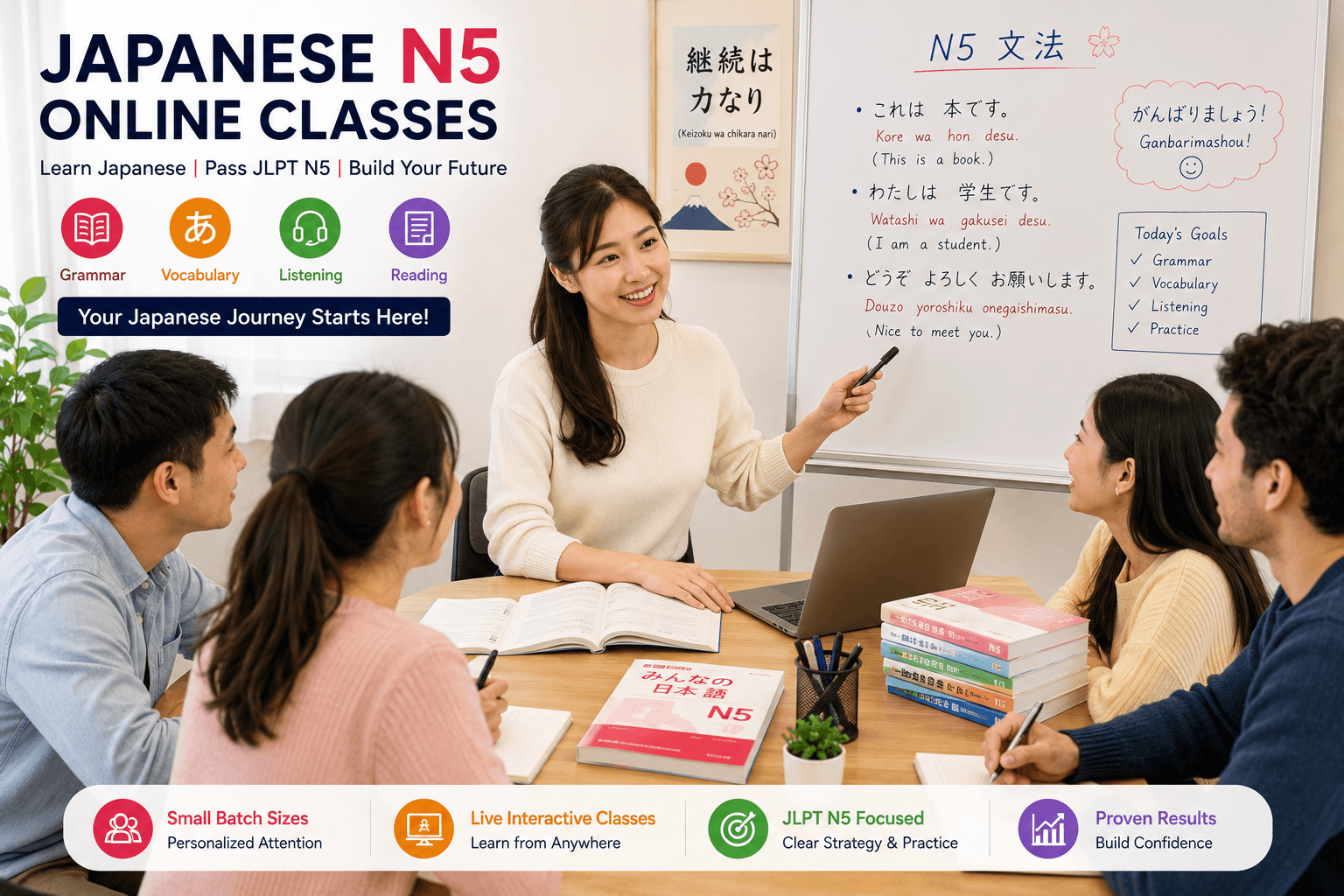
Japanese N5 online classes: Learning Japanese can feel challenging at first, especially when you encounter hiragana, katakana, kanji and a completely different sentence structure. Japanese N5 online classes provide beginners with a structured starting point for learning the language and preparing for the JLPT N5 examination.
For complete beginners, Japanese N5 online classes can help develop essential vocabulary, grammar, kanji, reading and listening skills under the guidance of an instructor. Students can study from home while gradually building the foundation required for higher Japanese proficiency levels.
For a complete overview of Japanese proficiency testing, exam levels, structure, and certification, explore our guide to Japanese JLPT exams .
A comprehensive N5 program should go beyond examination preparation. Students should also develop practical Japanese for travel, restaurants, everyday conversations and basic professional situations. If your long-term objective is employment involving Japanese, N5 can be the first step toward N4, N3 and eventually N2.
This guide explains what you can expect from Japanese N5 online classes, important N5 Japanese kanji, commonly studied grammar patterns, travel phrases, menu reading, JLPT preparation, employment possibilities, resumes, interviews, workplace Japanese, visas and how to progress from N5 to N2 while working.
Students looking for classroom-based learning can explore our Japanese classes in Bangalore to understand available learning options and course formats.
What Are Japanese N5 Online Classes?
Japanese N5 online classes are beginner Japanese lessons designed to develop the fundamental skills associated with JLPT N5. They are suitable for students who are completely new to Japanese as well as learners who have studied independently but need structured preparation.
A well-designed course generally covers:
- Hiragana and katakana
- Basic N5 Japanese kanji
- JLPT N5 vocabulary
- Beginner Japanese grammar
- Sentence construction
- Reading comprehension
- Listening comprehension
- Basic conversation
- Pronunciation
- JLPT-style exercises
- Practice tests and mock examinations
The advantage of studying through Japanese N5 online classes is that students can combine structured lessons with independent practice without needing to travel to a physical classroom.
Why Choose Japanese N5 Online Classes?
Flexibility is one of the main reasons students choose Japanese N5 online classes. Working professionals, university students and learners living far from a Japanese language institute can attend classes from home.
Live lessons can also provide something that recorded courses and apps cannot always offer: direct interaction with an instructor.
Students can ask questions about particles, sentence structures, pronunciation and kanji and receive immediate explanations.
Regular classes also create accountability. Instead of studying intensively for a few days and then stopping, learners can follow a structured timetable.
If you prefer personalised instruction, our comparison of Japanese language tutors online explains different tutoring platforms, pricing, teaching quality, and learning options.
For beginners who find Japanese difficult to organise independently, this structure can make learning considerably easier.
What Should Japanese N5 Online Classes Cover?
Good Japanese N5 online classes should develop more than the ability to answer JLPT questions.
Students should build a balanced foundation covering:
Writing systems: Hiragana and katakana
Kanji: Basic characters and their use in words
Vocabulary: Everyday words involving people, places, time, numbers, food, travel and daily activities
Grammar: Fundamental sentence structures and particles
Reading: Short sentences, notices and simple passages
Listening: Slowly spoken conversations involving familiar situations
Speaking: Basic introductions, questions and everyday conversations
JLPT preparation: Vocabulary, grammar, reading and listening exercises
Although JLPT does not directly test speaking and writing, these skills become increasingly important if you intend to use Japanese outside the examination.
Understanding JLPT N5
What Does Japanese N5 Mean?
JLPT stands for the Japanese-Language Proficiency Test. There are five levels:
| Level | General Stage |
|---|---|
| N5 | Beginner |
| N4 | Elementary |
| N3 | Intermediate |
| N2 | Upper-intermediate/advanced |
| N1 | Advanced |
N5 is the introductory level.
Someone completing Japanese N5 online classes should develop the ability to understand some basic Japanese, including common expressions and simple sentences written using hiragana, katakana and elementary kanji.
N5 should therefore be viewed as the beginning of Japanese proficiency rather than fluency.
JLPT N5 Exam Structure
Students taking Japanese N5 online classes should understand the examination format from the beginning.
The JLPT N5 examination evaluates three broad areas:
| Test Section | Current Testing Time |
|---|---|
| Language Knowledge – Vocabulary | 20 minutes |
| Language Knowledge – Grammar & Reading | 40 minutes |
| Listening | 30 minutes |
Speaking and writing are not directly tested.
For this reason, students whose goals extend beyond certification should combine JLPT preparation with practical conversation and writing practice.
N5 Japanese Kanji You Must Know
Kanji is one of the areas that concerns beginners most. However, students should approach it gradually rather than trying to memorise hundreds of isolated characters.
The JLPT does not provide a definitive official list guaranteeing exactly which kanji will appear. Nevertheless, Japanese N5 online classes commonly introduce elementary characters frequently encountered in beginner Japanese.
Examples include:
| Kanji | Meaning | Example |
|---|---|---|
| 日 | day/sun | 日本 |
| 月 | month/moon | 月曜日 |
| 火 | fire | 火曜日 |
| 水 | water | 水曜日 |
| 木 | tree | 木曜日 |
| 金 | gold/money | 金曜日 |
| 土 | earth | 土曜日 |
| 人 | person | 日本人 |
| 女 | woman | 女の人 |
| 男 | man | 男の人 |
| 子 | child | 子ども |
| 山 | mountain | 山 |
| 川 | river | 川 |
| 上 | up/above | 上 |
| 下 | down/below | 下 |
| 中 | middle/inside | 中 |
| 大 | big | 大きい |
| 小 | small | 小さい |
| 学 | study | 学生 |
| 生 | life/student | 学生 |
| 年 | year | 一年 |
| 時 | time/hour | 一時 |
| 円 | yen | 百円 |
| 本 | book/origin | 日本 |
| 車 | vehicle/car | 電車 |
A better approach is to learn kanji inside words and sentences rather than memorising characters without context.
For example:
私は学生です。
Watashi wa gakusei desu.
I am a student.
This approach simultaneously develops kanji recognition, vocabulary and grammar.
Grammar Patterns That Appear Most in JLPT N5 Preparation
Grammar is another major component of Japanese N5 online classes.
Rather than simply memorising rules, students should learn how grammar functions inside real sentences.
1. A は B です
One of the fundamental Japanese sentence patterns:
私は学生です。
Watashi wa gakusei desu.
I am a student.
2. ~ですか
Used to form basic questions.
学生ですか。
Gakusei desu ka?
Are you a student?
3. Basic Particles
Beginners should become comfortable with particles such as:
は – wa
Topic marker
が – ga
Subject marker
を – o
Object marker
に – ni
Time/destination
で – de
Location of an action
の – no
Possession/relationship
と – to
With/and/quotation
も – mo
Also
For example:
私は日本語を勉強します。
Watashi wa Nihongo o benkyō shimasu.
I study Japanese.
4. あります and います
These expressions describe existence.
猫がいます。
Neko ga imasu.
There is a cat.
本があります。
Hon ga arimasu.
There is a book.
5. ~ません
A basic polite negative form.
肉を食べません。
Niku o tabemasen.
I don't eat meat.
6. ~たいです
Used to express what you want to do.
日本へ行きたいです。
Nihon e ikitai desu.
I want to go to Japan.
7. ~てください
Used for simple requests.
見てください。
Mite kudasai.
Please look.
A strong Japanese N5 online classes curriculum should provide extensive exercises so students learn to recognise and use these patterns rather than simply memorising definitions.
How to Read Japanese Menus at N5 Level
Learning to read a simple menu is an excellent practical exercise.
Students attending Japanese N5 online classes can start recognising common food-related words and kanji.
Useful words include:
水 – water
ご飯 – rice/meal
肉 – meat
魚 – fish
野菜 – vegetables
牛肉 – beef
豚肉 – pork
鶏肉 – chicken
お茶 – tea
コーヒー – coffee
ラーメン – ramen
カレー – curry
Useful restaurant expressions include:
これは何ですか?
Kore wa nan desu ka?
What is this?
いくらですか?
Ikura desu ka?
How much is it?
これをください。
Kore o kudasai.
This one, please.
水をお願いします。
Mizu o onegaishimasu.
Water, please.
Practical exercises like these make beginner Japanese more useful than studying exclusively for an examination.
Travel Japanese: N5 Phrases You'll Actually Use
Travel is another situation where N5 knowledge can immediately become useful.
Students taking Japanese N5 online classes should practise phrases such as:
すみません。
Sumimasen.
Excuse me / Sorry.
ありがとうございます。
Arigatō gozaimasu.
Thank you very much.
駅はどこですか?
Eki wa doko desu ka?
Where is the station?
トイレはどこですか?
Toire wa doko desu ka?
Where is the toilet?
いくらですか?
Ikura desu ka?
How much is it?
わかりません。
Wakarimasen.
I don't understand.
もう一度お願いします。
Mō ichido onegaishimasu.
Once again, please.
英語を話しますか?
Eigo o hanashimasu ka?
Do you speak English?
These phrases demonstrate how N5 grammar and vocabulary can be applied to real situations.
Japanese N5 for Online Job Applications
Can N5 help with employment?
Yes, but it is important to present the qualification accurately.
Completing Japanese N5 online classes and obtaining JLPT N5 certification demonstrates that you have established a basic foundation in Japanese. However, N5 should not normally be presented as professional fluency.
Its employment value becomes stronger when combined with another skill.
For example:
Software development + Japanese N5
Engineering + Japanese N5
International sales + Japanese N5
Digital marketing + Japanese N5
Hospitality experience + Japanese N5
Your professional expertise may be the primary qualification while Japanese becomes an additional advantage.
How to Frame N5 on a Resume for Maximum Impact
Avoid writing:
Japanese – Fluent
if you only hold N5.
A more accurate presentation would be:
Japanese – JLPT N5 certified | Basic reading and listening | Currently preparing for N4
Another option is:
Languages: Japanese – JLPT N5 | Continuing structured study toward N4
Candidates completing Japanese N5 online classes can also mention relevant practical skills when genuinely acquired, such as basic conversation or the ability to read simple Japanese.
The objective is to communicate progress without overstating proficiency.
Interview Questions in Japanese at N5 Level
Students interested in employment should practise simple interview-style questions alongside their regular lessons.
Useful questions include:
お名前は何ですか?
Onamae wa nan desu ka?
What is your name?
どこから来ましたか?
Doko kara kimashita ka?
Where are you from?
仕事は何ですか?
Shigoto wa nan desu ka?
What is your job?
日本語を勉強していますか?
Nihongo o benkyō shite imasu ka?
Are you studying Japanese?
日本が好きですか?
Nihon ga suki desu ka?
Do you like Japan?
Actual professional interviews may be considerably more advanced than N5. Therefore, learners should continue developing speaking skills after completing Japanese N5 online classes.
N5 Study Materials That Help With Job Interviews
Students whose long-term objective is employment should not rely entirely on JLPT multiple-choice practice.
Combine JLPT preparation with:
- Vocabulary flashcards
- Kanji exercises
- Listening practice
- Self-introduction practice
- Speaking sessions
- Mock interviews
- Workplace vocabulary
- Profession-specific vocabulary
- Simple email writing
- Question-and-answer exercises
You can also record a one-minute Japanese self-introduction and listen to it afterwards. This helps identify hesitation and pronunciation problems.
Beginners preparing for their first JLPT level can review the complete Japanese N5 syllabus to understand the kanji, vocabulary, grammar, reading, and listening topics they need to study.
Japanese Email Writing for N5 Professionals
Professional Japanese emails can involve formal language and business conventions that extend well beyond N5.
Nevertheless, Japanese N5 online classes can introduce students to the basic structure of written communication.
A very simple beginner example could be:
田中さん
こんにちは。
ありがとうございます。
よろしくお願いします。
Sanjeev
As students progress through N4, N3 and N2, they can gradually learn more appropriate business expressions, formal communication and keigo.
N5 learners should therefore view basic email writing as an introduction rather than mastery of Japanese business correspondence.
Common Workplace Japanese Phrases for N5 Workers
Practical workplace expressions can be introduced during Japanese N5 online classes, particularly for students learning Japanese for career purposes.
おはようございます。
Good morning.
ありがとうございます。
Thank you.
わかりました。
Understood.
わかりません。
I don't understand.
もう一度お願いします。
Please say it again.
お願いします。
Please.
すみません。
Excuse me / Sorry.
お疲れ様です。
A widely used workplace expression acknowledging someone's work.
Learning these expressions helps students begin understanding Japanese workplace communication, although N5 alone is not sufficient for many Japanese-speaking professional positions.

Remote Work Opportunities with N5 Japanese
Remote work has created opportunities for professionals to work internationally without relocating immediately.
However, there is no universal category of "N5 jobs."
Someone with strong professional expertise and basic Japanese may find opportunities involving:
- Software and IT
- International operations
- Data-related work
- Digital marketing
- Global customer operations
- Travel-related businesses
- Localisation support
- International e-commerce
- Companies connecting Japan with overseas markets
For many such positions, English or technical expertise may remain the primary working skill.
Students completing Japanese N5 online classes should therefore continue improving Japanese while strengthening their core professional expertise.
N5 Japanese Certification Value for Employers
JLPT N5 is useful because it provides a recognised indication that you have reached an introductory milestone in Japanese.
It may demonstrate:
- Commitment to learning Japanese
- Basic reading ability
- Basic listening comprehension
- Familiarity with hiragana
- Familiarity with katakana
- Knowledge of elementary kanji
- Understanding of basic grammar
- Motivation to progress further
However, the JLPT does not directly assess speaking or writing.
Employers can therefore conduct their own interviews or assessments to determine practical Japanese ability.
Comparing N5 to Other Language Proficiency Levels
Students often ask:
Is Japanese N5 equivalent to A1?
There is now an official CEFR reference indication associated with JLPT scores. For N5, successful candidates scoring 80 or above can receive an A1 reference indication for the competencies measured by the JLPT.
However, this comparison needs context.
JLPT primarily evaluates language knowledge, reading and listening. It does not directly evaluate speaking and writing.
Therefore, learners should avoid assuming that an N5 certificate automatically demonstrates every skill associated with broader communicative frameworks.
Networking Strategies When Your Japanese Is Limited
You don't need to wait until you reach N2 before interacting with Japanese speakers.
Students enrolled in Japanese N5 online classes can begin networking by preparing a simple introduction.
Learn how to communicate:
- Your name
- Your country
- Your profession
- Your interests
- Why you are learning Japanese
- What industry you work in
Then participate in language exchanges, cultural events, professional communities and relevant online groups.
Don't pretend your Japanese is stronger than it is. Simple, confident communication combined with a willingness to learn creates a better impression than exaggerated proficiency claims.
If you want to build your Japanese skills remotely, our guide on how to learn Japanese online covers practical approaches to studying speaking, vocabulary, grammar, reading, and listening.
New learners can also read our complete guide on how to learn the Japanese language for a step-by-step approach to progressing from beginner-level fundamentals to more advanced Japanese.
Cities Where N5 Is More Acceptable for Employment
There isn't an official list of Japanese cities where JLPT N5 is "accepted" for employment.
Language requirements depend primarily on the employer, occupation and nature of the job.
However, major international business centres such as Tokyo, Osaka, Yokohama, Nagoya, Kyoto and Fukuoka have diverse employers and international business activity.
An international technology company might operate largely in English, whereas a customer-facing position in the same city could require considerably stronger Japanese.
Students taking Japanese N5 online classes should therefore search for jobs according to their profession and required Japanese proficiency rather than choosing a city based only on N5.
Cost of Living on Typical N5-Level Salaries
There is no standard "N5 salary."
JLPT N5 is a language qualification, not an occupation.
Salary depends on factors such as:
- Profession
- Education
- Experience
- Employer
- Industry
- City
- Technical skills
- Japanese ability
- Employment status
For example, an experienced software engineer with N5 Japanese could earn a completely different salary from an entry-level worker who also has N5.
Likewise, living costs vary substantially between locations and lifestyles.
Instead of searching for an "N5 salary," compare salaries for your actual profession against accommodation, transportation, food, utilities, insurance, taxes and other living expenses.
Visa Requirements Related to N5 Employment
This is one of the most important areas for students considering Japan.
Passing JLPT N5 does not automatically qualify someone for a Japanese work visa.
Japan has different statuses of residence, and eligibility depends on the type of work, qualifications and immigration category.
For example, the Specified Skilled Worker (i) route generally requires applicants to demonstrate Japanese proficiency through JFT-Basic or JLPT N4 or higher, alongside relevant skills testing, with certain fields having additional requirements.
Therefore, completing Japanese N5 online classes should not be interpreted as automatically meeting Japanese immigration requirements.
Always check the latest official immigration rules for the specific status of residence and occupation you intend to pursue.
Age Discrimination and Language Level in Japan
Students sometimes worry that their age combined with beginner Japanese will make employment impossible.
There is no useful equation such as:
Age + N5 = unemployable.
Employers can consider many factors:
- Professional experience
- Education
- Technical expertise
- Communication ability
- Japanese proficiency
- English proficiency
- Industry knowledge
- Visa eligibility
- Suitability for the position
Experienced candidates should position Japanese as an additional skill alongside their existing professional expertise.
Someone with 10 years of valuable industry experience and N5 Japanese has a very different profile from someone entering the workforce with no experience.
How to Transition from N5 to N2 While Working
Completing Japanese N5 online classes should be considered the first milestone rather than the final objective.
A practical progression is:
N5 → N4 → N3 → N2
N5 to N4
Strengthen basic grammar, expand vocabulary and kanji, and increase everyday listening.
N4 to N3
Begin reading longer texts, listening to more natural conversations and expressing more complicated ideas.
N3 to N2
Move increasingly toward authentic Japanese.
Use:
- Japanese news
- Podcasts
- Workplace conversations
- Articles
- Emails
- Meetings
- Profession-specific vocabulary
- JLPT reading material
Working professionals can use a simple daily routine:
Morning: 15 minutes vocabulary and kanji
Lunch: 15 minutes reading
Evening: 30 minutes grammar or structured lessons
Walking/commuting: Japanese listening
Weekend: Longer lesson and mock-test practice
Consistency over months is more effective than studying intensively for a short period and stopping.
Japanese N5 Online Classes vs Self-Study
Can you prepare for N5 independently?
Yes.
Many learners successfully combine books, apps, videos and free online resources.
However, Japanese N5 online classes offer advantages for students who need structure and interaction.
| Self-Study | Japanese N5 Online Classes |
|---|---|
| Highly flexible | Structured learning |
| Often inexpensive | Instructor guidance |
| Learn at your own pace | Regular schedule |
| Many free resources | Immediate doubt clarification |
| Limited correction | Teacher feedback |
| Requires discipline | Greater accountability |
| Speaking can be difficult | Live conversation practice |
A hybrid approach often works particularly well: attend structured classes and use independent study for daily revision.
Students planning to take JLPT N5 can read our detailed Japanese N5 exam guide to learn about the exam pattern, sections, preparation, and testing requirements.
How to Choose the Best Japanese N5 Online Classes
Before joining Japanese N5 online classes, evaluate the actual course structure rather than choosing entirely on price.
Check whether the program includes:
1. Complete beginner preparation
A beginner should be taught hiragana and katakana rather than being expected to know them already.
2. Structured kanji learning
Kanji should be introduced progressively through vocabulary and sentences.
3. Grammar explanations
Students should understand why a sentence works rather than simply memorising patterns.
4. Reading practice
Reading should gradually move from individual sentences toward short passages.
5. Listening exercises
Listening needs regular practice because it forms an important part of JLPT N5.
6. Live speaking practice
Even though speaking isn't directly tested by JLPT, it matters for practical Japanese.
7. JLPT mock examinations
Practice examinations help students understand timing and question formats.
8. Teacher feedback
Regular correction helps identify mistakes before they become habits.
9. Practical Japanese
Look for courses incorporating travel, restaurants, introductions and everyday situations.
10. Progression beyond N5
Good Japanese N5 online classes should provide a clear pathway toward N4 and higher levels.
How Long Does It Take to Complete Japanese N5 Online Classes?
There is no single study duration suitable for every learner.
The time required depends on:
- Previous language-learning experience
- Number of weekly classes
- Daily self-study
- Ability to learn kanji
- Attendance
- Revision
- Exposure to Japanese
Students who attend classes but never revise will generally progress more slowly than learners who combine lessons with daily practice.
Even 30–60 minutes of consistent self-study outside class can make a substantial difference.
How to Study Effectively During Japanese N5 Online Classes
To get maximum value from Japanese N5 online classes, divide your study time across different skills.
For example:
Monday: Vocabulary + kanji
Tuesday: Grammar + sentence creation
Wednesday: Listening
Thursday: Reading
Friday: Vocabulary revision
Saturday: Speaking + practical Japanese
Sunday: Mock questions + weekly review
Use spaced repetition for vocabulary and kanji rather than attempting to memorise large lists in a single session.
Common Mistakes Students Make at Japanese N5
Beginners frequently make several mistakes.
Ignoring Hiragana and Katakana
Relying excessively on romaji delays reading development.
Memorising Kanji Without Vocabulary
Learn characters through real words.
Studying Grammar Without Creating Sentences
Write your own examples.
Ignoring Listening
Reading alone will not prepare you properly for the listening section.
Studying Only for the Examination
JLPT preparation is useful, but practical communication makes Japanese valuable outside the test.
Expecting N5 to Create Immediate Fluency
N5 is a foundation.
Good Japanese N5 online classes should make this progression clear from the beginning.
How to Prepare for the Japanese N5 Exam
As your course progresses, gradually increase exam-oriented practice.
A simple preparation sequence is:
Learn → Practise → Review → Test → Identify mistakes → Review again
During the final stage of your Japanese N5 online classes, complete timed exercises so you become comfortable working under examination conditions.
Maintain a notebook of repeated mistakes.
Separate mistakes into:
- Vocabulary
- Kanji
- Particles
- Verb forms
- Grammar
- Reading
- Listening
Spend more revision time on categories where mistakes repeatedly occur.
Are Japanese N5 Online Classes Worth It?
For students who value structured learning, teacher interaction and regular feedback, Japanese N5 online classes can be an effective way to begin Japanese.
They can be particularly useful if you:
- Are a complete beginner
- Have difficulty studying consistently alone
- Want JLPT N5 preparation
- Need help with grammar
- Want pronunciation correction
- Need speaking practice
- Plan to progress toward N4, N3 and N2
- Want to use Japanese for travel or future employment
The value ultimately depends on course quality and how consistently the learner practises outside class.
What Comes After Japanese N5?
Passing N5 isn't the end of Japanese learning.
Think of the levels as a progression:
N5: Build the foundation.
N4: Expand basic Japanese.
N3: Move toward intermediate comprehension.
N2: Develop substantially broader Japanese comprehension and move closer to the level useful for many Japanese-intensive professional situations.
N1: Highest JLPT level.
Students beginning Japanese N5 online classes with employment as their eventual objective should create a long-term plan rather than stopping immediately after obtaining N5 certification.
Frequently Asked Questions About Japanese N5 Online Classes
1. How long does it actually take to reach Japanese N5 level?
There is no fixed number of months because learning speed depends on your study schedule, previous language-learning experience and how consistently you practise. A learner attending Japanese N5 online classes several times a week and reviewing vocabulary, kanji and grammar daily will usually progress faster than someone studying occasionally. Instead of focusing only on the number of months, aim for consistent mastery of the N5 syllabus and skills.
2. Is Japanese N5 hard for a complete beginner?
JLPT N5 is the introductory JLPT level, but Japanese can still feel challenging to a complete beginner. Hiragana, katakana, kanji, particles and Japanese sentence structure may all be unfamiliar. Structured Japanese N5 online classes can make these areas easier by introducing them gradually rather than asking students to learn everything at once.
3. Can I pass JLPT N5 in three months?
It may be possible for some highly consistent learners, but three months should not be treated as a guaranteed timeline. Your starting level, weekly study hours, memory, listening exposure and practice all matter. If you want an accelerated plan, combine regular classes with daily vocabulary, kanji, grammar, reading and listening practice.
4. Can I learn Japanese N5 in one month?
For a complete beginner, trying to develop a solid N5 foundation in only one month is extremely intensive. You may learn basic phrases, hiragana, katakana and some elementary grammar, but examination readiness is another matter. A sustainable study plan is generally more useful than rushing through material simply to finish it.
5. Do I need to learn hiragana and katakana before starting N5?
You don't necessarily need to know them before joining beginner Japanese N5 online classes because a complete beginner course can teach them from the beginning. However, hiragana and katakana are fundamental. Learning them early will make vocabulary, grammar, reading and kanji study considerably easier.
6. How many kanji do I need to know for JLPT N5?
You will need familiarity with elementary kanji, but be careful with websites claiming that the JLPT guarantees one exact official kanji list. The JLPT does not publish a definitive modern list of every kanji that can appear. Your N5 Japanese kanji preparation should concentrate on common beginner characters and, importantly, how they are used in actual vocabulary and sentences.
7. What grammar should I study for JLPT N5?
N5 learners should become comfortable with fundamental sentence structures, verb forms and particles such as は, が, を, に, で, の and と. Common beginner constructions include ~です, ~ですか, ~ません, ~てください, あります and います. Good Japanese N5 online classes should teach these structures through sentences and exercises rather than isolated memorisation.
8. Is N5 Japanese listening harder than reading?
Some students find listening more difficult because spoken Japanese disappears immediately, whereas written Japanese gives you time to examine a sentence. Regular exposure helps. Listen to short beginner conversations repeatedly, first for the general meaning and then for individual words, particles and expressions.
9. Can I learn N5 Japanese without a teacher?
Yes. Motivated learners can use textbooks, videos, flashcards, apps, official practice questions and other resources. However, a teacher can help explain grammar, correct pronunciation and provide feedback. Japanese N5 online classes are particularly useful for students who find it difficult to maintain a structured study routine independently.
10. Is self-study or an online Japanese N5 course better?
Neither method is automatically better for everyone. Self-study provides maximum flexibility and can cost less, while a structured course provides teacher guidance, accountability and opportunities to ask questions. Many students get the best results by combining Japanese N5 online classes with independent daily revision.
11. Are free Japanese N5 courses enough to pass JLPT N5?
Free resources can be extremely useful, but the quality and completeness vary. A collection of free videos may teach vocabulary and grammar without providing a coherent learning sequence. If you use free resources, create a structured plan covering vocabulary, kanji, grammar, reading and listening, and regularly test yourself with JLPT-style questions.
12. How do I choose the right Japanese N5 online classes?
Look beyond advertisements and course fees. Check the syllabus, teacher experience, class size, number of teaching hours, live interaction, kanji coverage, grammar instruction, listening practice, speaking opportunities, mock tests and whether students can ask questions. The best Japanese N5 online classes should provide a clear learning pathway rather than simply access to recorded videos.
13. Are one-to-one Japanese N5 lessons worth the cost?
They can be worthwhile for learners who want personalised attention, have unusual schedules or need intensive help with specific weaknesses. Group Japanese N5 online classes, however, may be more affordable and also allow interaction with other learners. The better choice depends on your budget and preferred learning style.
14. How much should I study every day for JLPT N5?
Consistency matters more than occasionally studying for several hours. Even a manageable daily routine covering vocabulary, kanji, grammar and listening can build momentum. If you attend classes, revise the material soon after each lesson rather than waiting until just before the examination.
15. How can I balance a full-time job with Japanese N5 study?
Create short, repeatable study periods. You could revise vocabulary and kanji in the morning, listen to Japanese during your commute or walk, and spend 30–45 minutes on grammar or reading in the evening. Weekend Japanese N5 online classes can provide structure while weekday micro-sessions keep the language fresh.
16. What happens if I fail JLPT N5 the first time?
Failing N5 does not mean you cannot learn Japanese. Use your result and practice performance to identify whether vocabulary, grammar, reading or listening needs more attention. Strengthen those areas and attempt the examination again when you are better prepared. Your actual language development is more important than passing on the first attempt.
17. Can I take the JLPT N5 exam online from home?
Do not confuse Japanese N5 online classes with the official JLPT examination. Studying can be done online, but candidates should check the official JLPT website and their local test organisation for the current test locations, dates and registration procedures. Do not assume that an online course means the official examination can also be taken from home.
18. Is JLPT N5 enough to speak Japanese fluently?
No. N5 represents introductory Japanese ability, not fluency. In addition, JLPT does not directly test speaking. A student can therefore pass N5 while still finding spontaneous conversation difficult. If speaking is important to you, choose Japanese N5 online classes that include conversation practice alongside exam preparation.
19. What is the difference between JLPT N5 and N4?
N5 establishes the basic foundation, while N4 requires a broader understanding of elementary Japanese. N4 involves more vocabulary, kanji, grammar, reading and listening ability. Students who complete N5 should generally view N4 as the next stage rather than repeatedly studying only beginner material.
20. Should I aim higher than N5 if I want to work in Japan?
Usually, yes. N5 can demonstrate that you have started learning Japanese, but many jobs requiring Japanese expect substantially stronger communication ability. Your ideal target depends on your profession, but progressing through N4 and N3 toward N2 can greatly expand what you can understand and do in Japanese.
21. Can I get a job in Japan with only N5 Japanese?
It is possible in some circumstances, but N5 alone should not be treated as a job qualification. Your occupation, education, experience, technical skills, English ability, visa eligibility and employer's language requirements all matter. The source material itself highlights this as one of the most frequently recurring student concerns.
A software professional with extensive experience and N5 Japanese, for example, has a very different employment profile from someone relying entirely on N5 certification.
22. Is N5 enough for an IT job in Japan?
It depends heavily on the company and position. Some international technology teams operate substantially in English, while other employers require Japanese for meetings, documentation and communication with clients. N5 may complement strong technical skills, but it should not be assumed to satisfy the language requirements of every IT job.
23. Do Japanese employers care about JLPT N5 certification?
N5 can demonstrate commitment and basic progress, but employers usually care about whether your Japanese is sufficient for the actual position. They may also assess your speaking ability during an interview. N5 is therefore better presented as a recognised beginner milestone rather than evidence of professional Japanese proficiency.
24. How should I mention JLPT N5 on my resume?
Be precise rather than exaggerating your ability. For example:
Japanese – JLPT N5 certified | Basic reading and listening | Currently studying toward N4
This is stronger and more credible than writing "Japanese – Fluent." If you are currently taking Japanese N5 online classes but haven't passed the examination, don't claim certification; state that you are currently studying at N5 level.
25. What Japanese questions should I prepare for a basic interview?
Start with simple questions about your identity, country, profession and Japanese studies. Examples include お名前は何ですか? (What is your name?), 仕事は何ですか? (What is your job?) and 日本語を勉強していますか? (Are you studying Japanese?).
However, a professional interview can be considerably more advanced than N5. Practise a short Japanese self-introduction and profession-specific vocabulary in addition to JLPT material.
26. What Japanese workplace phrases should an N5 learner know?
Useful beginner expressions include おはようございます (good morning), ありがとうございます (thank you), わかりました (understood), わかりません (I don't understand), すみません (excuse me/sorry), and もう一度お願いします (please say it again).
These expressions are useful starting points, but they do not replace the more advanced Japanese required in many workplaces.
27. Can N5 Japanese help me find remote work?
Potentially, particularly when Japanese is an additional skill rather than the main qualification. Someone with expertise in software development, design, marketing, international operations or another field may benefit from basic Japanese when working with Japanese clients or companies. However, jobs requiring substantial communication in Japanese will normally expect stronger proficiency.
28. Is N5 enough to live and travel independently in Japan?
Basic N5 Japanese can certainly help with greetings, shopping, restaurants, numbers, transportation and simple questions. You may recognise signs and understand basic phrases. However, real-life conversations can quickly become more complex than textbook N5 Japanese, so N5 should not be considered complete independence in every situation.
Learning practical phrases alongside Japanese N5 online classes is therefore valuable for anyone planning to visit Japan.
29. Is age a problem when starting Japanese N5?
No age prevents someone from beginning Japanese. The source questions specifically include concerns about learning N5 as an older adult, showing that this is a genuine concern among prospective learners.
For employment, age and language ability are separate considerations. Employers may evaluate experience, qualifications, Japanese proficiency, technical ability and suitability for the position. Older professionals should emphasise their existing expertise while developing Japanese as an additional skill.
30. How can I progress from N5 to N2 while working full-time?
Treat Japanese as a long-term progression:
N5 → N4 → N3 → N2
After completing Japanese N5 online classes, don't stop studying. Increase vocabulary and kanji at N4, develop more substantial reading and listening at N3, and gradually expose yourself to authentic Japanese as you approach N2.
Working professionals can use short daily study sessions combined with longer weekend lessons. Vocabulary review, kanji, podcasts, reading, conversation and structured lessons can all become part of the routine. The goal is consistent improvement rather than trying to jump from N5 to N2 immediately.
Final Advice for Students Considering Japanese N5 Online Classes
If you are a complete beginner, don't worry about jobs, N2 or advanced business Japanese before establishing the basics. Start by developing hiragana, katakana, elementary kanji, vocabulary, grammar, listening and simple conversation.
Good Japanese N5 online classes should help you build that foundation while preparing you for JLPT N5. Once your N5 foundation is strong, you can continue toward N4, N3 and N2 according to your academic, travel or career goals.
The most useful approach is to treat N5 as your first measurable milestone in Japanese, not the final destination.
Conclusion
Japanese N5 online classes provide a structured entry point into Japanese for complete beginners. Students can develop hiragana, katakana, N5 Japanese kanji, essential vocabulary, grammar, reading and listening while preparing systematically for the JLPT N5 examination.
However, the real value of Japanese N5 online classes extends beyond obtaining a certificate. A strong course can help learners order food, understand basic menus, communicate while travelling, introduce themselves, understand simple workplace expressions and establish the language foundation required for higher JLPT levels.
For career-focused learners, N5 should be considered the beginning rather than the final objective. Combine Japanese with your professional expertise, represent your N5 qualification accurately on your resume and continue progressing through N4 and N3 toward N2 if your career requires stronger Japanese.
Choosing structured Japanese N5 online classes, practising consistently and using Japanese outside your textbook can transform N5 from a simple examination milestone into the first stage of genuine Japanese-language proficiency.
For structured learning from home, explore our Japanese online classes covering language skills, JLPT preparation, and progressive Japanese learning.
Related Posts