German B1 Online Classes: Courses, Exams, Jobs & Costs
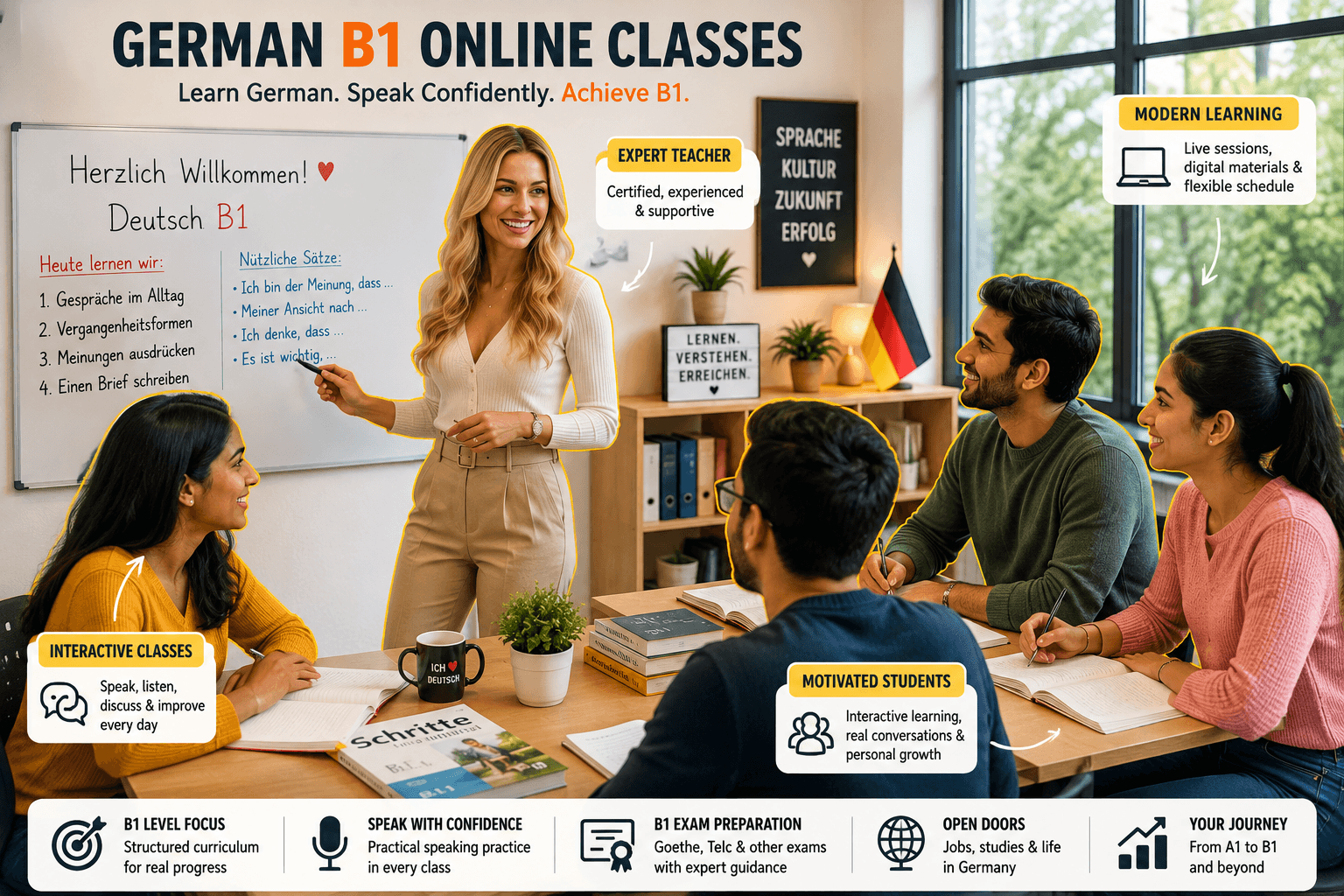
German B1 Online Classes: Reaching the B1 level in German is an important milestone for anyone learning the language for higher education, employment, relocation or everyday communication in Germany. At this stage, learners move beyond basic phrases and begin communicating independently in many familiar situations.
German B1 online classes provide a flexible way to develop these skills without being restricted by location. A well-structured B1 German language course generally combines grammar, vocabulary, speaking, listening, reading and writing with regular feedback from a teacher.
However, learning B1 German is about more than completing another language level. Students frequently want to know how long B1 takes, what B1 courses cost, which examinations are recognised, whether B1 is enough for employment in Germany and what opportunities become available after certification.
This guide explores the complete German language B1 level, including online learning, B1.1 to B1.4, examinations, free resources, course costs, textbooks, conversation practice, employment opportunities and life in Germany.
Learn German Online: Students who want to study from home can explore different ways to learn German online while developing speaking, listening, reading, writing and grammar skills.
What Is B1 Level German?
The B1 level German standard is part of the Common European Framework of Reference for Languages (CEFR). It represents an intermediate stage between elementary German and upper-intermediate proficiency.
At the German language B1 level, learners should generally be able to understand the main points of clear communication about familiar subjects, handle many everyday situations while travelling, produce connected text about familiar topics and describe experiences, plans and opinions.
For someone who has completed A1 and A2, a B1 German course represents a noticeable transition toward independent communication.
Instead of learning isolated sentences such as how to order food or introduce yourself, you begin learning how to explain problems, participate in longer conversations, write structured messages and understand more natural German.
German B1 Level: To understand what you should be able to communicate after reaching intermediate proficiency, explore our detailed guide to the German B1 level .
What Do You Learn in German B1 Online Classes?
A comprehensive B1 German language course should develop all four major language skills: speaking, listening, reading and writing.
Students normally work on intermediate grammar alongside practical communication. Common areas include subordinate clauses, relative clauses, adjective endings, prepositions, past forms, modal structures, connectors and increasingly complex sentence construction.
Vocabulary also expands considerably. Topics may include:
- Work and careers
- Education and training
- Housing
- Health and appointments
- Travel and transportation
- Banking and shopping
- Technology and media
- Environment
- Relationships and society
- Government and public services
- Everyday life in Germany
Good German B1 online classes should not become grammar-only courses. Students need opportunities to speak, listen and receive corrections.
Students planning to study in Germany can review the German language requirements for international students at Heidelberg University to understand how German proficiency and recognised language certificates are used for university admission.
B1 German Sub-Levels Explained: B1.1 to B1.4
Students searching for B1.1 German or B1.2 German may wonder whether these are separate CEFR qualifications.
Officially, B1 is one CEFR proficiency level. Language institutes often divide it into smaller modules to make teaching and scheduling easier.
For example, a school might offer B1.1 and B1.2, while another divides the same overall curriculum into B1.1, B1.2, B1.3 and B1.4.
Broadly, the progression may look like this:
B1.1: transition from A2 into intermediate grammar and communication.
B1.2: development of vocabulary, sentence complexity and longer conversations.
B1.3: more independent speaking, reading and writing.
B1.4: consolidation of B1 competencies and preparation for a B1 examination.
Students should therefore compare the total curriculum and teaching hours, rather than assuming that a course containing four sub-levels is automatically more advanced than one containing two.
How Long Does It Take to Learn B1 German?
There is no universal number of months required to reach B1.
A learner beginning from zero must first develop A1 and A2 proficiency. Someone already comfortable at A2 can concentrate directly on B1.
The time required depends on previous language experience, teaching quality, lesson frequency, exposure to German and how consistently the student practises outside class.
Searches such as “B1 German in 3 months” are understandable, but three months can be demanding unless the learner already has a strong A2 foundation and can dedicate substantial time to German.
The goal should be genuine B1 ability rather than simply finishing a course quickly.
Learners looking for additional language exposure can explore the Language and Culture Exchange at TU Berlin to discover language-learning and intercultural opportunities available within a German university environment.
Recommended Weekly Study Time for German B1
Consistency is usually more productive than occasional long study sessions.
Students attending online classes can supplement lessons with regular independent practice. A learner might dedicate several hours each week to a combination of lessons, vocabulary revision, listening, reading, writing and conversation.
For example, someone with limited time could practise for 30–60 minutes on most days, while an intensive learner may study considerably longer.
Rather than asking only, “How many hours should I study?”, track whether you are improving across all four skills.
If your grammar improves but you still struggle to speak spontaneously, more conversation practice is necessary.
German B1 Course Pricing Comparison
The cost of a German B1 course varies significantly depending on the provider and format.
Self-paced courses are generally among the least expensive options. Group German B1 online classes can offer a balance between affordability and live teacher interaction. Private tutoring is usually more expensive per hour but provides personalised instruction.
Intensive courses may have higher total fees because they contain more teaching hours within a shorter period.
When comparing prices, don't look only at the headline course fee. Check:
Total teaching hours: A ₹15,000 course containing significantly more instruction may provide better value than a ₹10,000 short programme.
Group size: Smaller groups usually allow more speaking time.
Teacher feedback: Find out whether assignments and writing exercises are actually corrected.
Materials: Determine whether textbooks, mock tests and recordings are included.
Exam preparation: Some courses charge separately for exam-oriented training.
The cheapest B1 German language course is not necessarily the most economical if additional tutoring is eventually required.
Monthly Costs of German Language Courses
Monthly expenditure depends heavily on learning format.
Students using mostly free resources may spend very little. Subscription-based platforms introduce a predictable monthly fee, while live group courses and private tutors can cost substantially more.
Before enrolling, calculate the effective monthly cost and cost per teaching hour.
Also account for textbooks, examination fees, tutoring, language apps and conversation sessions. This produces a more realistic picture of what reaching B1 will actually cost.
Free Resources to Prepare for the B1 German Exam
Paid courses are not the only way to prepare.
Learners can combine structured teaching with free German-learning materials, listening exercises, vocabulary tools and official examination practice.
Useful categories of free resources include:
- Official B1 model tests
- German podcasts
- German-language news written for learners
- YouTube lessons
- Vocabulary flashcards
- Online grammar exercises
- Language-exchange communities
- Publicly available worksheets
Students searching for a B1 German course free should nevertheless make sure their learning covers speaking and writing. These are difficult to evaluate entirely on your own.
German B1 Exam: If certification is your goal, read our German B1 exam guide to understand the exam structure, preparation methods and the four major language skills assessed.
VHS Free Online German Courses
Germany's Volkshochschulen (VHS) are adult education centres offering education across many subjects, including German.
The VHS-Lernportal provides digital German-learning resources and can be useful for learners looking for structured supplementary study.
Free online resources can be particularly useful for revision, vocabulary and additional practice alongside teacher-led German B1 classes.
Students should check current course availability, eligibility and programme details directly with the relevant VHS service because individual offerings can differ.
German Language Course: Students looking for a structured learning pathway from beginner to advanced levels can explore our German language course covering German from A1 through the higher CEFR levels.
German B1 Textbooks and Workbooks
A structured textbook can prevent online learners from jumping randomly between unrelated resources.
Popular B1 materials typically contain reading passages, listening exercises, grammar explanations, vocabulary activities, writing tasks and speaking exercises.
When selecting a German B1 textbook, consider whether you need:
Coursebook: for structured progression through B1.
Workbook: for additional exercises and homework.
Grammar book: for targeted practice.
Vocabulary book: for systematic German B1 Wortschatz development.
Exam preparation book: for Goethe, telc or another specific examination.
A book should support your learning structure rather than replace communication with real people.
Using Anki for German B1 Vocabulary
Students searching for Anki German B1 resources can use spaced repetition to retain vocabulary over longer periods.
Rather than memorising isolated German-English word pairs, create cards containing sentences and context.
For example, learning a verb together with its preposition and a natural sentence is usually more useful than memorising the verb alone.
Anki is particularly effective when used consistently in short sessions.
German B1 Syllabus: Before starting B1, explore the complete German B1 syllabus to understand the grammar, vocabulary, speaking, listening, reading and writing skills covered at this intermediate level.
Mobile Apps vs Desktop Platforms for B1 German
Mobile apps are convenient for vocabulary, short exercises and daily revision.
Desktop learning environments tend to be better for longer writing assignments, live classes, detailed grammar work and mock examinations.
At B1, relying entirely on an app can become limiting because intermediate language learning requires longer conversations and more complex written production.
A practical strategy is to use mobile applications for daily reinforcement and a laptop or desktop for structured classes and serious assignments.
Preply Freelance Teachers for German B1
Platforms such as Preply connect learners with independent German tutors.
This can be useful for students who want flexible scheduling, one-to-one conversation practice or targeted help with specific weaknesses.
Because tutors work independently, teaching methods, qualifications, prices and experience can vary significantly.
Before selecting a tutor for B1 German, review their experience teaching intermediate students, whether they correct written work and whether they have experience preparing learners for your intended examination.
A trial lesson can help determine whether the teaching style suits you.
Why German Learners Sometimes Leave Bad Reviews on Learning Platforms
Negative reviews of online German courses do not always mean the platform itself is poor.
Common reasons for dissatisfaction include mismatched expectations, inconsistent tutors, large class sizes, insufficient speaking practice, scheduling problems and expecting fluency from a short course.
Some students also enrol in a B1 programme without having mastered A2. They then find the course excessively difficult.
Before choosing German B1 online classes, check exactly what is included rather than relying solely on star ratings.
How to Get Teacher Feedback on B1 Assignments Online
Teacher feedback becomes particularly important at B1 because students are expected to produce longer written and spoken responses.
Ask whether your course includes correction of:
- Emails and letters
- Opinion writing
- Grammar exercises
- Speaking tasks
- Pronunciation
- Mock examination answers
A useful correction should do more than identify a mistake. Ideally, the teacher explains why it is incorrect and shows how the sentence could be expressed naturally.
Keep a personal error log. Repeatedly reviewing your own common mistakes can produce substantial improvement.
Online Language Exchange Partners for B1
Language exchange allows learners to practise German with native or advanced speakers while helping the other participant practise another language.
At B1, exchanges become especially useful because you have enough vocabulary to sustain longer conversations.
Agree on a structure before starting. For example, spend 30 minutes speaking German and 30 minutes using the partner's target language.
Choose themes such as work, travel, education or current affairs instead of repeating basic introductions every week.
German B1 Conversation Clubs and Communities
Conversation clubs can bridge the gap between classroom German and spontaneous communication.
Unlike textbook exercises, group discussions require you to listen to different speakers, respond quickly and express ideas without preparing every sentence.
Online communities can also provide accountability and regular exposure to German.
However, peer practice should supplement rather than completely replace qualified correction because learners can unintentionally reinforce each other's mistakes.
Preparing for German B1 Certification
Learners may pursue B1 certification German for employment, education or personal goals.
Common searches include Goethe German B1, telc German B1 and CEFR B1 German.
Before registering, check which certificate is accepted by the organisation requesting proof of German ability.
Exam preparation should include timed practice in the relevant examination format. Knowing German and knowing how to approach a particular examination are related but different skills.
Use official model tests whenever possible rather than relying exclusively on unofficial mock examinations.
German Language Certification: If you are learning German for studies, employment or international opportunities, learn more about German language certification and the role of recognised proficiency examinations.
From A1 to B1 German
Students often search for an A1 to B1 German course because they want a continuous learning pathway.
The progression can be understood simply:
A1: basic introductions and everyday survival communication.
A2: routine communication about familiar situations.
B1: independent communication across a broader range of everyday subjects.
The transition becomes progressively more demanding because vocabulary grows, sentences become more complex and learners are expected to communicate with less preparation.
Success Stories: From A1 to C1 Through Online Learning
It is possible to progress from beginner to advanced German primarily through online learning, but successful learners rarely depend on a single resource.
A typical successful pathway combines structured classes, independent study, extensive listening, regular conversation, writing corrections and real-world exposure.
Someone progressing from A1, A2 and B1 German toward B2 and C1 should expect the nature of learning to change.
At advanced levels, simply completing exercises becomes less important than consuming authentic German and communicating regularly.
Success should therefore be measured by what you can actually do in German, not simply by the number of certificates accumulated.
Can You Get a Job in Germany With B1 German?
B1 can expand employment possibilities, but it does not guarantee a job.
Whether B1 German language proficiency is sufficient depends heavily on the occupation.
Some internationally oriented technology and engineering roles operate substantially in English. Other jobs involving customers, documentation, healthcare, government procedures or extensive communication may require B2, C1 or occupation-specific German.
A B1 certificate can demonstrate progress, but employers are often interested in whether candidates can communicate effectively during interviews and at work.
Most In-Demand Jobs for B1 German Speakers in Germany
Opportunities for people with intermediate German may exist in areas such as logistics, hospitality, manufacturing, technical occupations, selected IT positions and some skilled trades.
However, German requirements vary enormously between employers.
Regulated professions can have formal language requirements considerably above B1.
Therefore, don't choose an occupation solely because an online article says “B1 is enough.” Examine current vacancies in your profession and compare the language requirements employers actually specify.
Employer Attitudes Toward B1 German Certification
Employers can view B1 certification positively because it demonstrates a measurable level of language learning.
But the certificate and practical ability are not identical.
An employer may conduct part of an interview in German even when you have a recognised B1 certificate. Your ability to understand instructions, communicate with colleagues and explain work-related issues can matter more than the certificate itself.
For international companies where English is the primary working language, B1 may be considered an additional advantage rather than a core requirement.
Real Salary Comparisons by Job Type and German Level
German proficiency can affect access to jobs, but it would be misleading to claim that reaching B1 automatically increases someone's salary by a fixed amount.
Salary is influenced by occupation, qualifications, experience, industry, company size and city.
For example, a software professional working primarily in English may see little direct salary difference between A2 and B1. A customer-facing professional, by contrast, may become eligible for a broader range of roles after improving German.
The better way to compare salaries is by combining job title + city + experience + required German level.
When reviewing vacancies, compare similar roles requiring:
English only → A2/B1 German → B2 German → C1/professional German.
This reveals whether stronger German expands the number or quality of opportunities within your particular profession.
Company Sponsorship for a German Visa With B1
German ability and visa eligibility are separate questions.
Having B1 German can strengthen a candidate's employment profile in some sectors, but B1 certification by itself does not create a right to employer visa sponsorship.
Immigration pathways depend on factors such as qualifications, occupation, employment offer, salary and the immigration route being used.
Some companies are experienced in recruiting international professionals and may assist with relocation and immigration procedures.
Always verify current visa requirements through official German government sources before making financial or career decisions.
Success Stories: Moving to Germany With B1
Many learners aim for B1 because they plan to live in Germany.
A successful transition usually involves much more than passing a language examination. New arrivals may need German for housing, registration, banking, transportation, healthcare, workplace communication and social interaction.
Someone arriving with B1 may not understand every conversation, but intermediate proficiency can make everyday independence considerably easier than arriving with very limited German.
The most successful learners continue studying after relocation rather than treating B1 as the end of their language journey.
Integration Challenges When Moving to Germany With B1
B1 is useful, but real-world German can initially feel considerably harder than classroom German.
People speak at natural speed. Regional accents vary. Administrative vocabulary can be unfamiliar. Telephone conversations may be difficult because there are no visual cues.
Workplace German also contains terminology that general B1 courses may never cover.
These difficulties are normal parts of moving from controlled learning environments into authentic communication.
After arriving in Germany, continue listening, speaking and studying vocabulary related specifically to your job and daily responsibilities.
Best Cities in Germany for B1 German Speakers
There is no single “best city” for every B1 learner.
Berlin has a large international population and many English-speaking workplaces, particularly in technology and startups. Munich offers significant opportunities in technology, engineering and multinational companies but has relatively high living costs.
Frankfurt is an important financial and international business centre. Hamburg has opportunities across logistics, media, aviation and commerce. Cologne and Düsseldorf have diverse economies and international communities.
Smaller German cities can offer lower costs and excellent employment opportunities in particular industries, although daily life may require more frequent German communication.
Choose a city based on your profession, available jobs, housing costs and language environment, rather than language level alone.
Is B1 Enough to Live in Germany?
B1 can provide a strong foundation for independent everyday life, but it should not be considered the end of learning.
You may be able to shop, travel, make appointments, discuss familiar issues and handle many routine situations.
More complicated communication involving contracts, professional discussions, government correspondence or specialised healthcare may still be challenging.
Moving from B1 to B2 German can therefore make a substantial difference to professional and social confidence.
Should You Continue From B1 to B2 or C1?
For many learners, yes.
B1 establishes independence. B2 allows more detailed and spontaneous communication, while C1 supports sophisticated academic and professional language.
Your target should depend on your purpose.
Someone learning German for travel may be satisfied with B1. Someone seeking a customer-facing professional career in Germany may benefit considerably from B2 or C1.
Instead of asking, “Is B1 enough?”, ask “What German level does my specific goal require?”
How to Choose the Best German B1 Online Classes
Before enrolling in a German language B1 course, compare programmes using factors that directly affect learning quality.
Look at teacher qualifications, live teaching hours, batch size, curriculum, speaking opportunities, writing corrections, recordings, mock tests, course duration and examination preparation.
Ask the provider to explain how students are evaluated before moving to the next level.
Most importantly, choose a programme that makes you actively use German. Watching a teacher explain grammar for months is not the same as developing the ability to communicate.
How Long Does German Take?: Wondering how much time you need to progress through different proficiency levels? Read our guide on how long it takes to learn German to plan your learning journey realistically.
A Practical B1 German Study Routine
A balanced weekly routine could combine structured classes with independent learning.
Attend your scheduled German B1 classes, revise vocabulary regularly, complete grammar exercises, listen to German several times per week, write at least one meaningful text and participate in conversation practice.
Add periodic mock examinations if certification is your objective.
The combination matters. Vocabulary without speaking produces passive knowledge. Conversation without grammar can fossilise mistakes. Grammar without listening leaves students unprepared for natural German.
Frequently Asked Questions About German B1 Online Classes
1. Can You Learn German Online to B1 Level?
Yes. You can reach the B1 level German through structured online learning if the course includes speaking, listening, reading, writing, grammar and regular teacher feedback. Good German B1 online classes combine live lessons with independent practice and assessments. A structured B1 German language course is particularly useful because it gives learners a clear progression instead of relying entirely on apps or self-study.
2. How Long Does It Take to Reach B1 German?
The time required to reach German B1 depends on your starting level, weekly study hours and previous language-learning experience. A student already at A2 will usually progress much faster than someone starting from zero. Consistent German B1 classes, vocabulary revision, listening and speaking practice are more important than trying to complete a B1 German course within an unrealistic deadline.
3. Learning German B1 While Working Full-Time
Learning B1 German language while working full-time is possible when you have a realistic schedule. Many working professionals choose German B1 online classes because they eliminate commuting and provide more flexible lesson timings. Regular 30–60 minute study sessions during the week, combined with live German B1 classes, can be more sustainable than studying for several hours only on weekends.
4. Best German B1 Study Schedule for Busy People
A practical B1 level German study schedule should include grammar, vocabulary, listening, reading, writing and speaking throughout the week. Students taking a B1 German language course can revise lesson material for 30–60 minutes on most days and dedicate additional time to conversation and assignments. Consistency is more important than extremely long study sessions.
5. Is B1 German Difficult? What to Expect
The German language B1 level is more demanding than A1 and A2 because learners are expected to communicate independently and use longer, more complex sentences. However, German B1 is achievable with a strong A2 foundation and regular practice. A structured German language B1 course helps students gradually build grammar, vocabulary, listening comprehension and speaking confidence.
6. Free Online German B1 Courses That Actually Work
Free resources can support students who want to learn B1 German, particularly for grammar, vocabulary, listening and exam practice. However, completely free resources may provide limited feedback on speaking and writing. Combining free materials with teacher-led German B1 online classes or occasional tutoring can provide a more balanced approach to reaching the B1 level German.
7. German B1 Exam Preparation: Online Course Guide
A good German B1 exam preparation course should familiarise students with the format of the examination while strengthening their overall B1 German language ability. Look for mock tests, timed exercises, speaking practice, listening tasks and teacher corrections. Students preparing for Goethe or telc should ideally use official sample examinations alongside their B1 German language course.
8. How to Study for B1 German Exams Online
To prepare effectively for a German B1 exam, practise all four skills rather than concentrating only on grammar. Students taking German B1 online classes should complete model tests, listen to German regularly, practise speaking under time limits and ask teachers to correct written assignments. Exam preparation works best when it is combined with genuine B1 level German development.
9. Best German B1 Courses with Speaking Practice
The best B1 German course for speaking should provide frequent opportunities for students to answer questions, discuss topics, role-play everyday situations and receive pronunciation corrections. Before joining German B1 online classes, ask how much speaking time each student receives. A B1 German language course should develop practical communication rather than becoming mainly a grammar lecture.
10. Live vs Self-Paced German B1 Online Courses
Live German B1 online classes provide teacher interaction, immediate corrections and conversation practice, while self-paced programmes provide greater scheduling flexibility. Students who need accountability and speaking practice may benefit more from live German B1 classes. Self-paced learning can still be useful as a supplement to a structured German language B1 course.
11. German B1 Online Course with Real Teachers
A German B1 online course with real teachers can be particularly valuable at the intermediate level because students need personalised feedback on speaking and writing. Teachers can identify recurring grammar errors, improve pronunciation and explain difficult concepts. When selecting a B1 German language course, check whether lessons are actually teacher-led or mostly recorded content.
12. How Many Hours of Study for B1 German?
There is no fixed number of hours that guarantees the B1 level German because learners progress at different speeds. Students already at A2 may need significantly less time than complete beginners following a German A1 to B1 course. Regular exposure through a German B1 course, homework, vocabulary revision and conversation practice is usually more important than simply counting hours.
13. Online German B1 Courses with Certificates
Many German B1 online classes provide a course-completion certificate, but this should not automatically be confused with an internationally recognised B1 German certification. If you need certification for employment, education or another official purpose, check whether the organisation requires Goethe, telc or another recognised examination. A B1 German language course can prepare you for these exams, but the course certificate and examination certificate may be different.
14. Best Way to Learn German B1 at Home
The best way to learn B1 German at home is to combine structured classes with independent practice. Attend German B1 online classes, revise vocabulary, read short German texts, listen to German audio, complete writing assignments and practise conversation regularly. Using several skills together helps develop genuine B1 German language proficiency.
15. German B1 Online Tutors vs Group Classes
Private tutors provide individual attention and can customise lessons around your weaknesses, while group German B1 classes provide interaction with several learners and are generally more affordable. A student preparing for a specific examination may benefit from one-to-one tutoring, whereas a structured group B1 German language course can provide a good balance of teaching, speaking practice and cost.
16. How to Know If You're Ready for B1 German
You are generally ready to begin the German language B1 level when you have a comfortable foundation in A2 grammar, vocabulary, reading, listening and basic conversation. If you struggle considerably with basic A2 sentences, strengthening A2 before beginning a B1 German course may make learning easier. Many institutes use placement tests before admitting students into German B1 classes.
17. Cheapest Way to Learn German to B1 Level
The cheapest way to reach the B1 level German is usually to combine free or inexpensive self-study resources with selected teacher support. Free vocabulary tools, listening materials, grammar exercises and model tests can reduce costs. However, paying for a structured B1 German language course or occasional speaking lessons may save time by correcting mistakes before they become habits.
18. Is Online German B1 as Good as In-Person Classes?
Well-designed German B1 online classes can be as effective as classroom learning when they include live interaction, speaking practice, assignments and feedback. Online learning also provides advantages such as flexible scheduling and no commuting. The quality of the B1 German course and the student's consistency matter more than whether lessons take place online or in a physical classroom.
19. German B1 Vocabulary List and Online Resources
A strong German B1 vocabulary foundation should cover work, education, travel, housing, health, relationships, technology and everyday life. Students can use vocabulary lists, flashcards and spaced-repetition systems alongside their B1 German language course. Learning words in complete sentences is generally more useful than memorising isolated vocabulary.
20. How to Practice German B1 Speaking Online Alone
Students can practise B1 German speaking alone by recording themselves answering questions, describing experiences, giving opinions and summarising short articles. Speaking aloud helps convert passive vocabulary into active B1 German language ability. However, students taking German B1 online classes should also seek teacher or conversation-partner feedback because self-practice cannot identify every pronunciation or grammar mistake.
21. Can I Get a Job in Germany with B1 German?
Yes, some jobs may be available with B1 level German, but the required language level depends strongly on the occupation and employer. Some international technology or technical roles may operate largely in English, while customer-facing or regulated professions may require B2 or C1. A German B1 certificate can strengthen your profile, but employers may also evaluate your practical communication skills.
22. What Jobs Can I Do with B1 German Level?
People with B1 German language skills may find opportunities in sectors such as hospitality, logistics, manufacturing, technical occupations, selected IT roles and certain skilled trades. Requirements vary between employers, so students completing a German B1 course should check actual job advertisements in their profession rather than assuming that one German level applies to every occupation.
23. Is B1 German Enough to Work in Germany?
For some jobs, German B1 can be sufficient, particularly where English is widely used or communication requirements are limited. Other occupations may require B1 B2 German language, B2 or C1 proficiency. Completing a B1 German language course can therefore be an important step toward employment, but students should verify the specific language requirements of their intended profession.
24. Can I Learn B1 German in 3 Months?
Reaching B1 German in 3 months may be possible for a learner who already has a strong A2 foundation and can study intensively. For a complete beginner, reaching genuine B1 level German within three months would generally be much more demanding. It is better to focus on measurable language ability than simply finishing a B1 German course quickly.
25. Is the B1 German Exam Difficult?
The German B1 exam can feel challenging because it evaluates reading, listening, writing and speaking rather than grammar knowledge alone. Students who have genuinely reached the German language B1 level and practise the examination format beforehand are usually better prepared. A targeted B1 German language course can help students identify weak areas before the exam.
26. What Questions Are Asked in the B1 German Test?
The exact tasks depend on the examination provider, but a B1 German test generally evaluates practical communication through reading, listening, writing and speaking activities. Students may need to express opinions, respond to everyday situations or communicate information clearly. A German B1 exam preparation course should use official model tests so learners become familiar with the relevant format.
27. Is B1 German Considered Fluent?
B1 level German is generally considered an intermediate level rather than full fluency. At the German language B1 level, learners can communicate independently in many familiar situations, but complex professional, academic or abstract conversations can still be difficult. Progressing from B1 to B2 German usually provides considerably greater fluency and flexibility.
28. How to Prepare for the B1 German Exam?
To prepare for the B1 German exam, practise all four language skills regularly and become familiar with the specific examination structure. Use official model tests, practise timed writing, improve listening comprehension and participate in speaking sessions. German B1 online classes that include mock examinations and teacher corrections can make preparation more systematic.
29. B1 German Speaking Practice - How to Improve Fast?
The fastest way to improve B1 German speaking is frequent active use of the language. Participate in conversation clubs, speak with teachers or language-exchange partners and practise explaining your opinions instead of memorising answers. Students taking a B1 German language course should try to speak during every lesson because speaking ability develops through repeated communication.
30. How to Know If I'm Ready for the B1 German Exam?
You may be ready for the German B1 exam when you can complete official practice tests within the allotted time and perform reasonably consistently across reading, listening, writing and speaking. A teacher from your German B1 online classes can also assess your weaknesses before registration. Passing mock tests consistently is usually a better readiness indicator than simply completing a B1 German course.
Final Thoughts
German B1 online classes can be an effective route from elementary German toward independent communication. The B1 stage is particularly important because students begin using German for longer conversations, structured writing, workplace situations and everyday problem-solving.
A strong B1 German course should combine grammar, vocabulary, listening, speaking, reading and writing rather than concentrating exclusively on exam preparation.
Free resources, VHS learning materials, textbooks, apps, Anki, language exchanges and conversation clubs can all strengthen your learning, but regular teacher feedback remains particularly valuable for speaking and writing.
For students planning to move to Germany, B1 level German can make everyday communication and integration easier and may expand employment possibilities. However, job eligibility, salaries and visa requirements depend on many factors beyond language proficiency.
Treat B1 as an important milestone rather than a finishing point. Whether your next objective is B1 certification German, employment in Germany or progression from B1 to B2 German and eventually C1, consistent real-world communication is what ultimately turns course knowledge into practical language ability.
German Classes in Bangalore: Learners who prefer instructor-led training can explore our German classes in Bangalore for information about German courses, learning levels and training options.
German Online Language Courses: If flexibility is important, explore our German online language courses to learn German through structured online training from A1 to advanced levels.
German for Study in Germany: Students planning higher education in Germany can read our guide to online German classes for students preparing to study in Germany and understand how language preparation can support their study-abroad journey.
Related Posts